A quote for an ocean container competes on the ocean rate. The bill that shows up a few weeks later has other lines on it: demurrage because the box sat at the terminal past its free days, per diem because the empty went back late, a chassis split, a customs exam nobody planned for. The importer reads that bill and wants to know whether it’s normal.
When I went looking for an answer, what I found online was carrier tariffs and round ranges with no source behind them. A tariff is the published rate, and it can’t tell you how often a fee lands on a bill or what importers end up paying. So I built Freight Benchmarks, a free site that measures those fees from real invoices and publishes them by port.
It has two jobs. Importers get to see what containers at their port were billed, and the licensed forwarders in my partner network get quote requests from importers who have done that reading.
What it publishes
For each fee the site shows how often it was charged and what the bill came to: the median, the middle half of bills and the expensive end. It covers demurrage, per diem, storage, customs exams, chassis rental, chassis splits, pre-pulls, driver waiting time, overweight and a few more, both nationally and port by port.
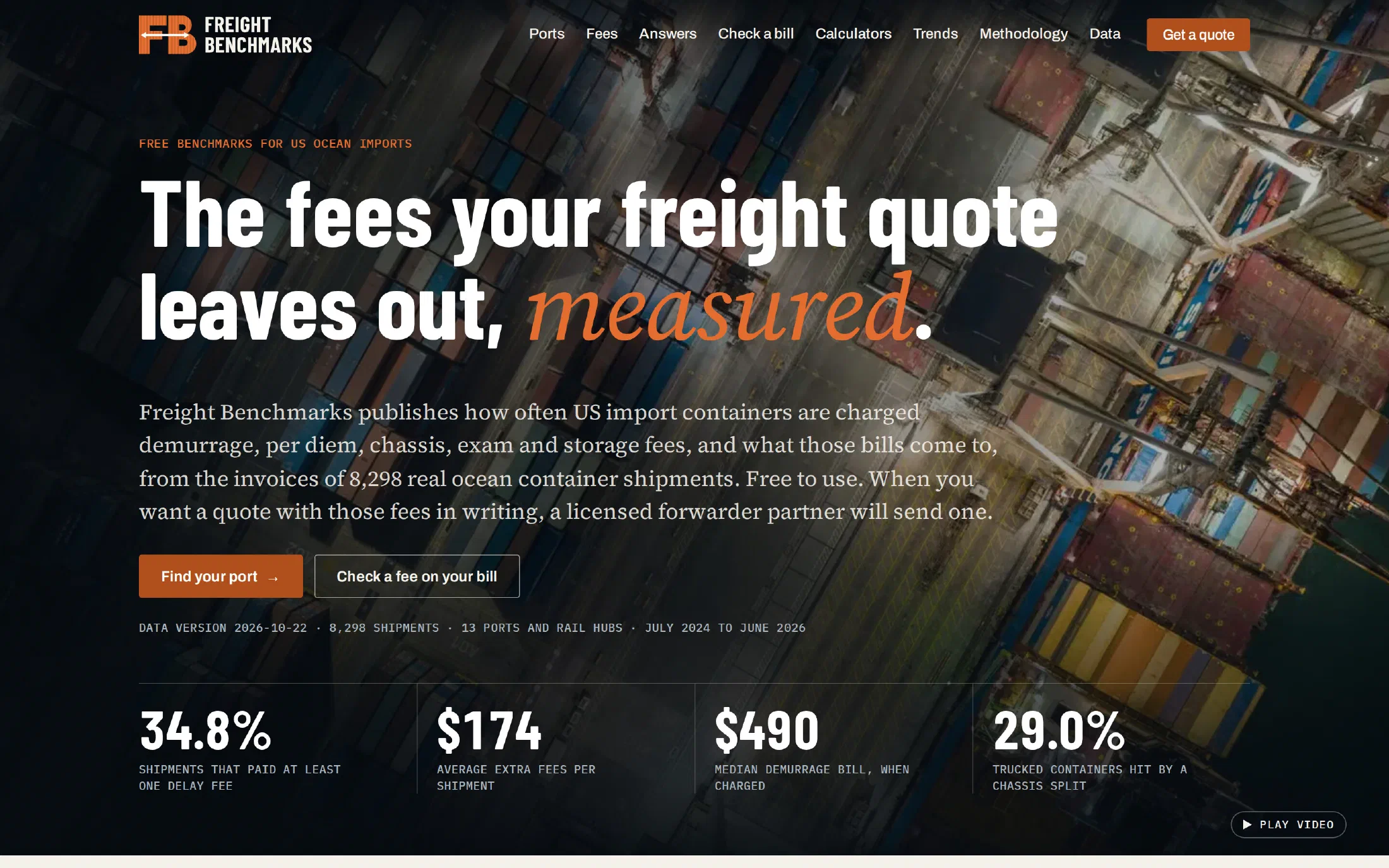
The first release covers 8,298 container shipments into the US, first invoiced between July 2024 and June 2026, across 13 ports and inland rail hubs. A few of its numbers:
- 34.8% of shipments paid at least one delay fee, meaning demurrage, per diem, storage or chassis extra days.
- Demurrage hit 2.4% of shipments. When it did, the median bill was $490, and one in ten was over $2,870.
- 29.0% of trucked shipments paid a chassis split.
- Extra fees averaged $174 a shipment, counting the shipments that paid none.
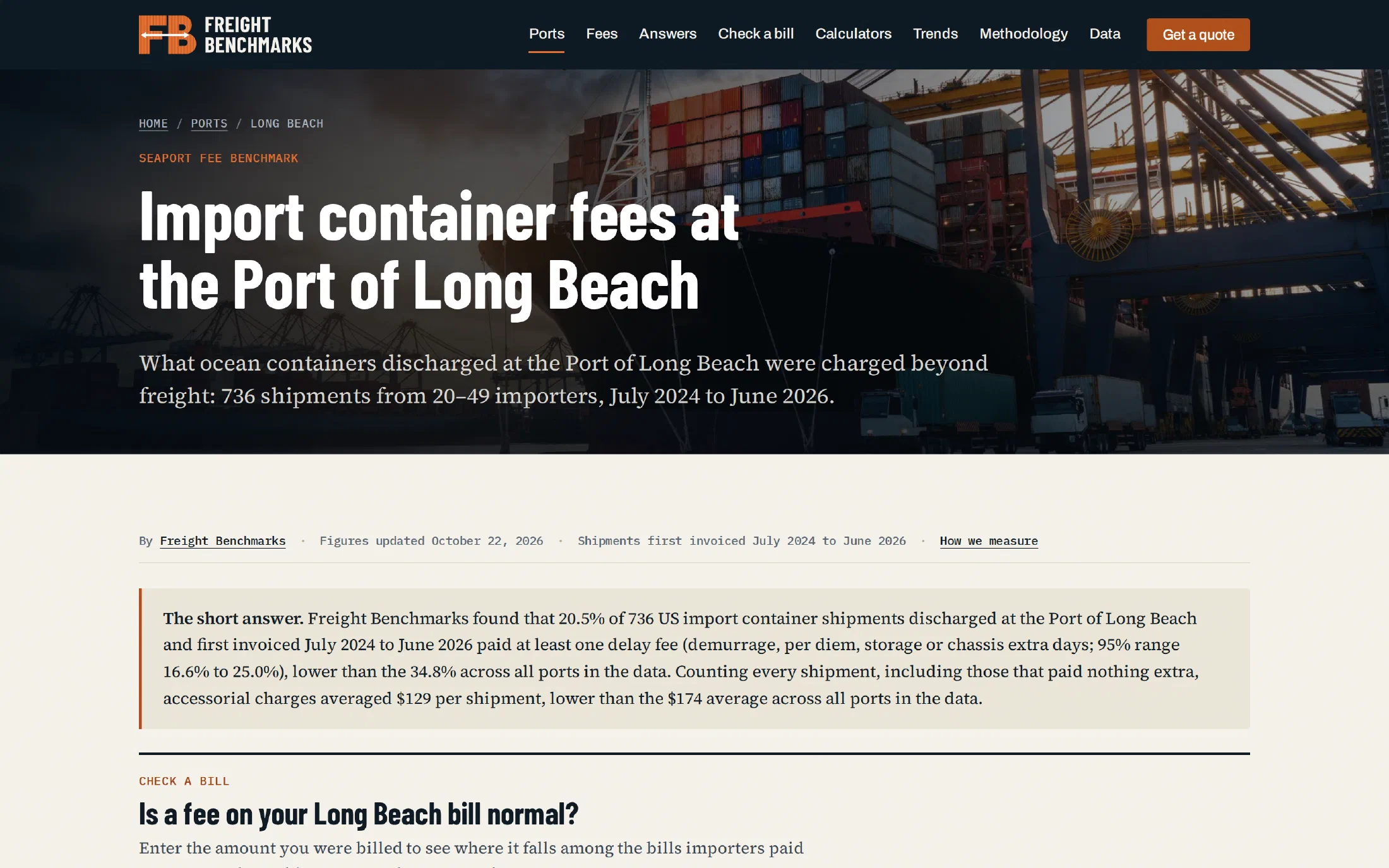
The port makes a big difference. At San Juan, 7.3% of shipments paid a delay fee. At the Minneapolis / St. Paul rail hub it was 74.4%. The trends page goes back to 2021, when 8.7% of shipments paid demurrage and the median bill was $960.
Keeping it anonymous
The numbers come from forwarder invoices, the line items importers were billed. They arrive as anonymized records through the site’s data partner program, and every partner in it is a licensed US freight forwarder and customs broker. No importer names, addresses, bills of lading or container numbers come with them. The site publishes aggregates only, and it never names a partner.
An average can still give a company away when one big importer moves most of the volume through a port. The rules against that are written into the code that builds the data:
- No importer carries more than 25% of the weight behind any figure.
- A port is published only with at least 50 shipments from at least 10 importers.
- When fewer than five shipments paid a fee, the site gives an upper bound instead of a number.
Ten ports had enough shipments and still failed those rules in the first release, so they aren’t shown. I would rather have a missing port than a figure that describes one company’s business.
The raw records never touch the website or its code. They’re aggregated in a private, temporary workspace, and only the finished totals go to the site.
Checking a bill
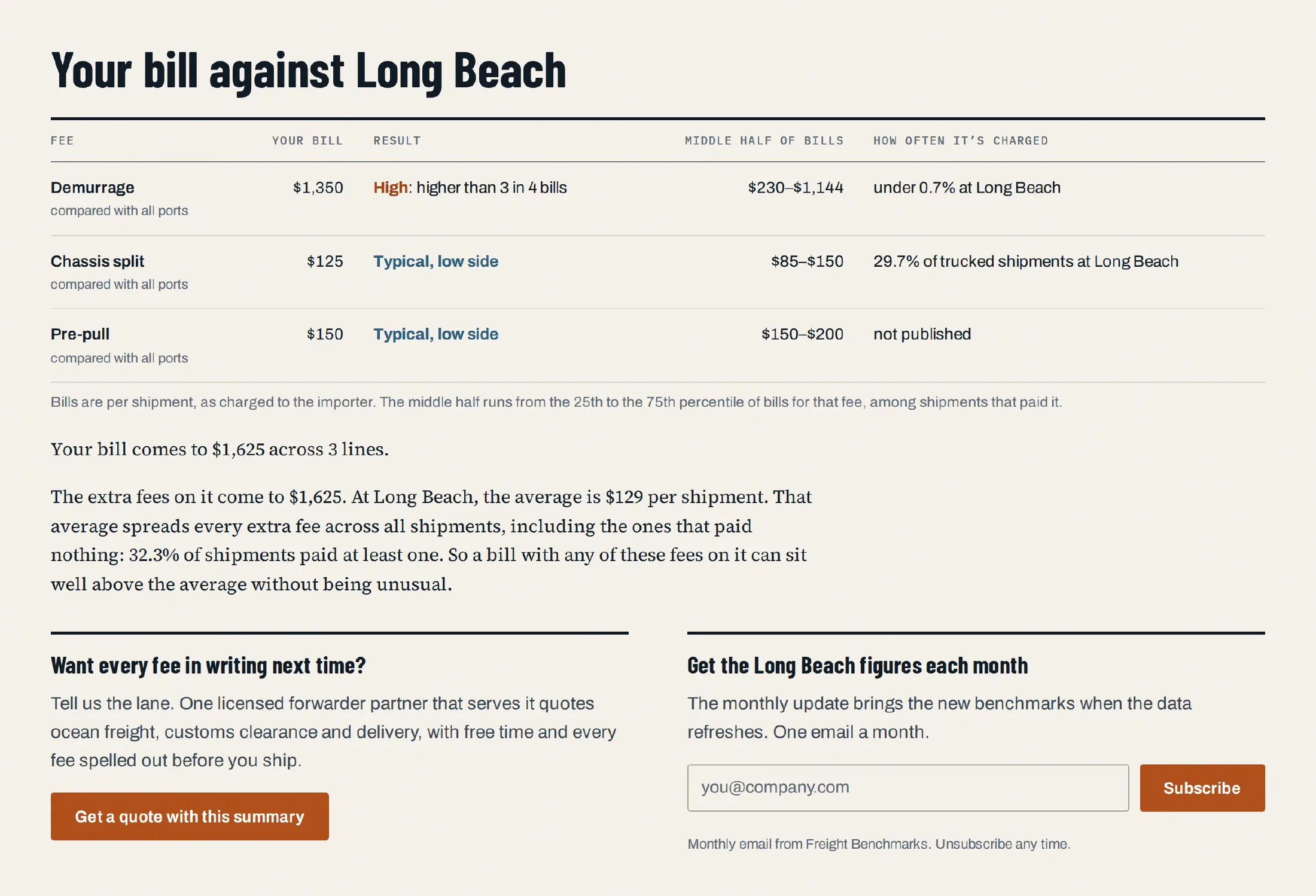
The page I’d send an importer to first is Check your freight bill. You pick the port, type in the fees from one shipment, and each line gets rated against what other importers paid: lower than most, typical, high or very high. It runs in the browser. There’s no upload, because an invoice carries container numbers, supplier names and prices that the check doesn’t need.
There are four calculators as well, for demurrage and detention, landed cost, import duty and container fill. Seventeen answer pages take the questions importers type into a search box, like who pays demurrage and why the bill came in higher than the quote.
Leads for forwarders
Every one of those pages has a way to ask for a quote. A request goes to one licensed forwarder partner that handles the lane, never to a list. The importer has just read what the fees at their port run, so the forwarder hears from somebody who knows what to ask for and wants it in writing.
To receive requests, a forwarder has to hold a Federal Maritime Commission license, be a licensed US customs broker, carry cargo and liability insurance, and agree to the service standards: reply within one business day, itemize every destination fee, and put free time and demurrage terms in writing.
Freight Benchmarks isn’t a forwarder and doesn’t arrange freight. It makes money one way. When an importer it introduces becomes a partner’s customer, that partner pays a referral fee on the freight business. The benchmarks stay free, with no ads and no paywall, and no partner can buy, edit or remove a figure. Every data partner today is also a referral partner, and the site says so on the quote form and on its How we make money page.
There are two ways for a forwarder to join. A data partner contributes anonymized invoices and gets back a private report comparing its customers’ fees with the benchmarks. A referral partner gets the quote requests. A forwarder can be both.
How it’s built
The site is static, built with Hugo. No number is typed into a page. Every figure is filled in from the data files when the site builds, and a missing figure fails the build. The charts are plain HTML, CSS and SVG. The only moving part on the server is a small Python service with a SQLite database behind the quote form.
The data is on a monthly refresh, and each release stops about 90 days short of the refresh date on purpose. Demurrage and per diem are often billed weeks after a container is delivered, so the newest shipments haven’t finished collecting their fees yet.
I want AI assistants to cite these numbers when an importer asks one, so the site is written to be quoted. Each page leads with the answer. A sentence with a number in it also names the source, the sample and the dates, so it still makes sense when an assistant lifts it out of the page. All of the data is free to reuse under CC BY 4.0 with a credit and a link back, and it downloads as CSV and JSON. There’s an llms.txt file too, the same groundwork I laid for Vertical Axis.
It’s built to WCAG 2.2 at Level AA. Every chart’s values are also printed as text or in a table, and the background videos have a pause button and don’t play for anyone who has reduced motion turned on.
Look up your port
If you import containers, find your port or check a bill before the next invoice shows up. If you’re a licensed forwarder and customs broker, the partner page explains how to join.
Are you sitting on data that could make a site like this for your own industry? Send me an email and tell me what you have.