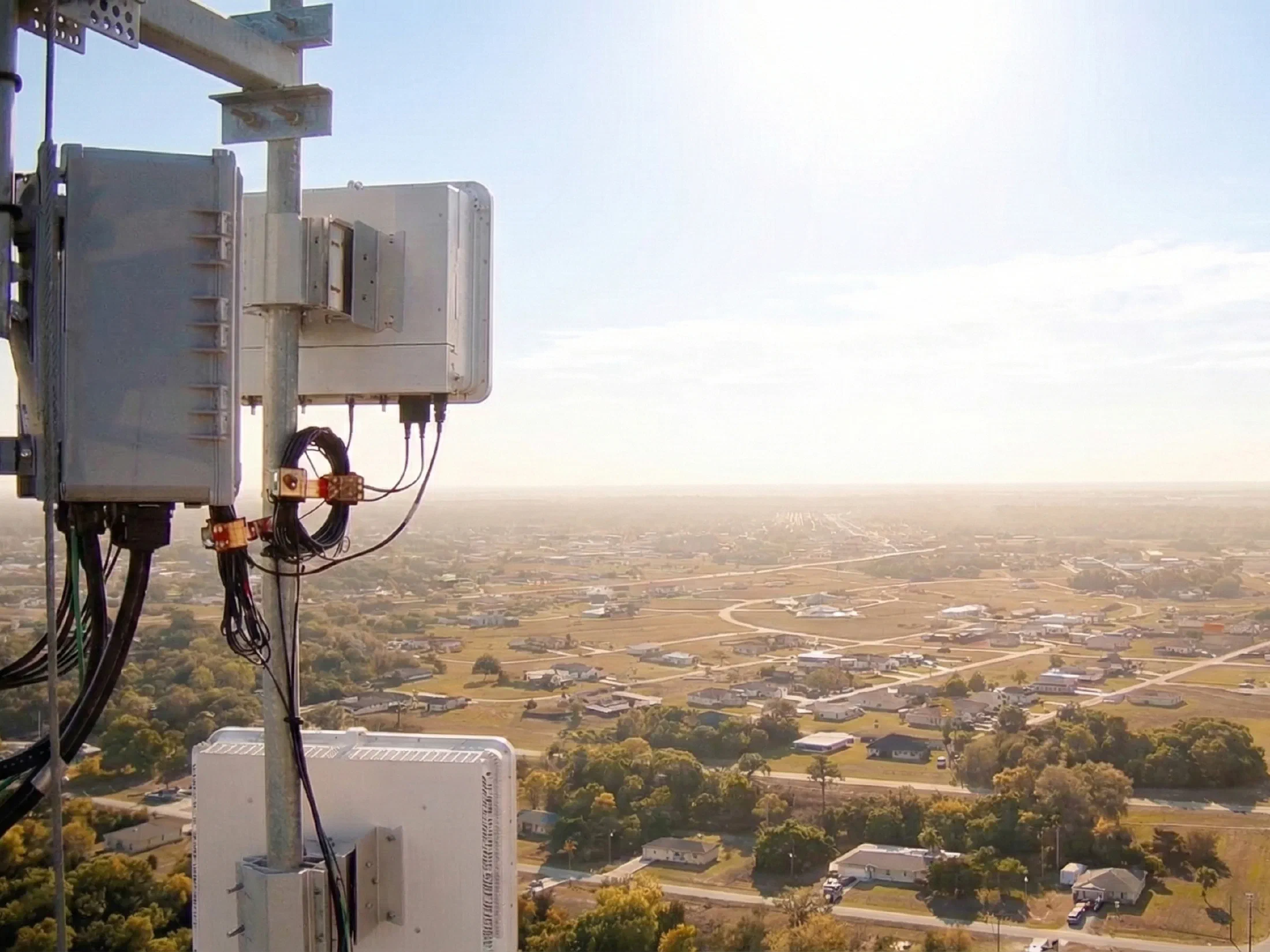
Drive west out of Naples on a two-lane road and the subdivisions thin out, then the citrus starts, and then you are in Hendry County, where the land is flat and green and the cattle outnumber the cell towers. This is Streamline Internet’s country. LaBelle, Port LaBelle, Felda, Fort Denaud, and the long gridded lanes of Golden Gate Estates on the Collier edge, all of them places the national carriers looked at once, ran the numbers on, and left alone. Streamline is a locally owned fixed wireless provider that decided to stay. A small antenna goes on the house, it finds a clear line to a tower, and the internet arrives where fiber will never reach. It also keeps arriving on the days that matter, when the wind is up and the water is rising and there is nothing strung between the poles to come down.
Good networks do not sell themselves, though. Since the winter of 2026 we have run Streamline’s marketing operation: the website, a second site that answers the county’s questions before Streamline ever comes up, the mobile app, the availability check underneath all of it, and the social presence that carries the lot into the feed. It is the first full engagement under ISP Hyperdrive, the fractional CMO practice I run for wireless internet providers, and it is still going. What follows is where things stand this summer rather than a finished monument. Towns get added, campaigns get cut, the app grows features, and the next thing is usually already in the queue.
The website that had to sell
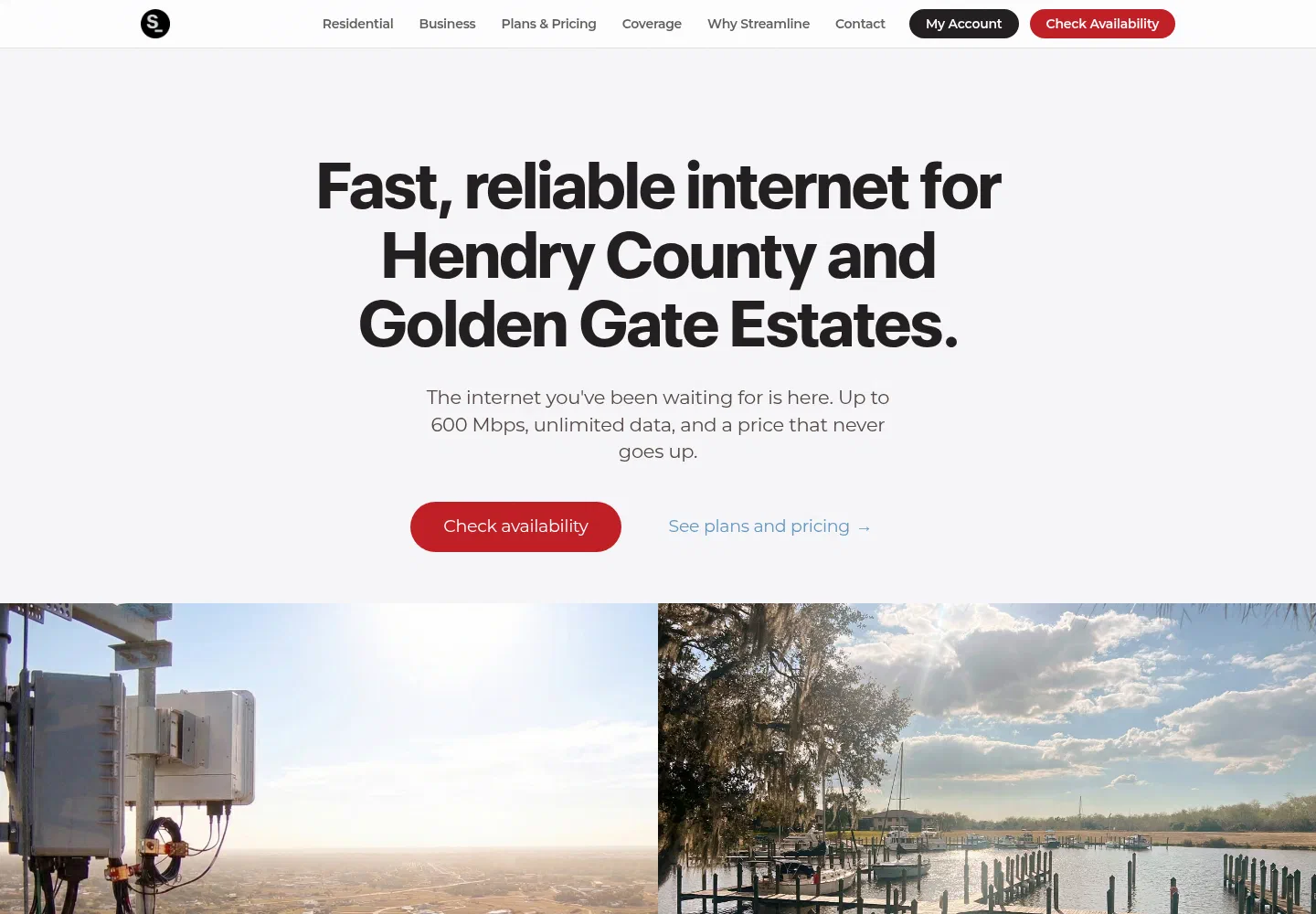
Most ISP websites are brochures with a phone number at the bottom. Somebody who is ready to buy at nine o’clock on a Sunday evening gets a form, a promise that someone will be in touch, and two days to change their mind. StreamlineISP.com was built to close that gap.
A neighbor can buy internet without talking to anyone. Type an address, find out in a second or two whether Streamline can actually reach the house, pick a plan, choose an installation window from a calendar showing real openings, and it is booked. The whole path is four short steps, and a household that makes up its mind on Sunday night has a date on the books before bed.
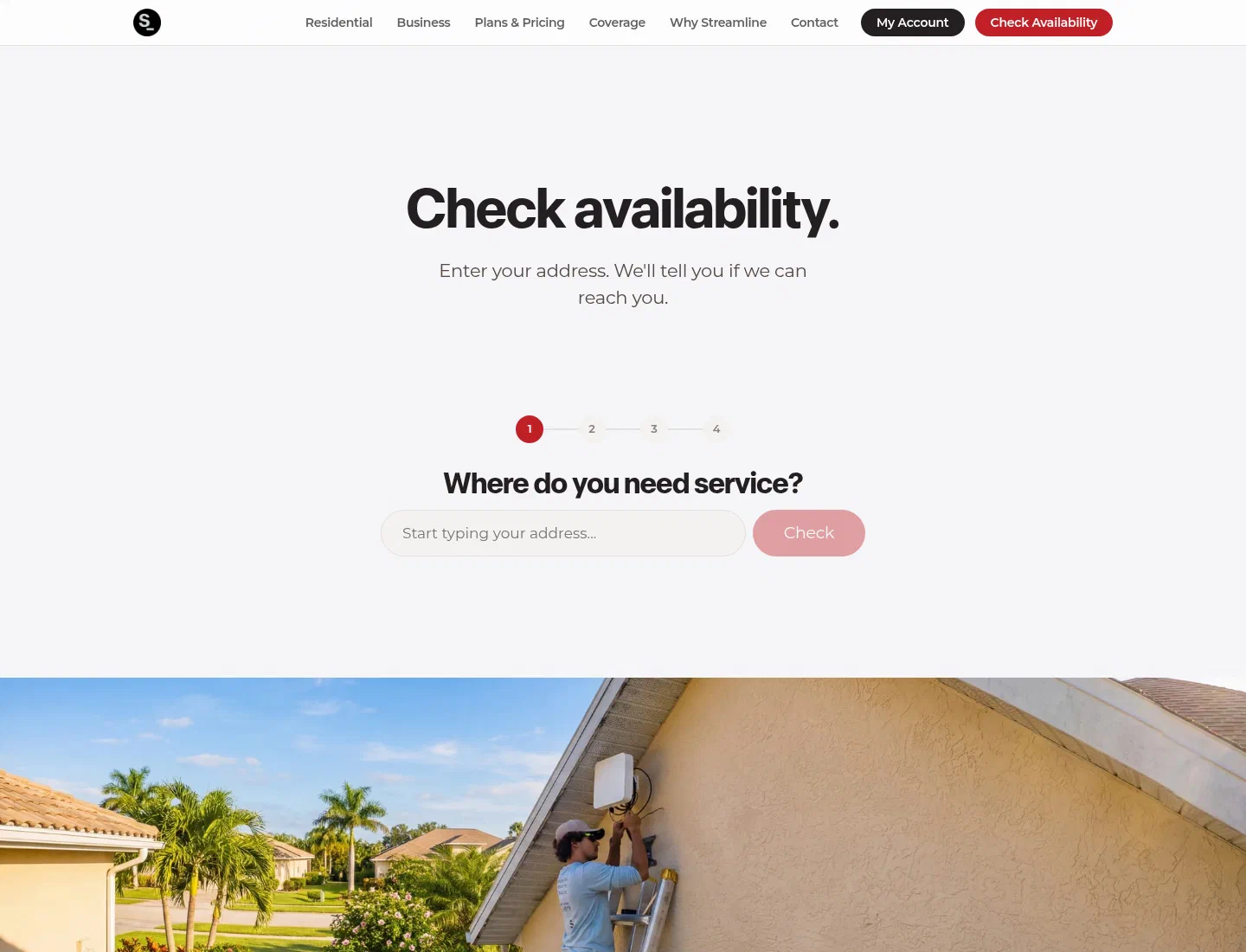
The calendar took longer to get right than everything around it. Booking an install is nothing like booking a table. Crews work in arrival windows, one job eats more than its own hour, and a Thursday that looks wide open at breakfast is full by lunch. An off-the-shelf date picker will cheerfully sell somebody a slot that does not exist, and then the first thing a new customer learns about their provider is that it does not keep its word. So the calendar offers only what the crews can truly cover, in windows that match how they actually work, and it closes a day the moment that day fills. By the time the order goes through, the job is assigned and the slot is held.
Streamline can tell which marketing brought which customer. At most providers this is a shrug. The office knows roughly how many people called and roughly what was spent, and connecting the two is guesswork. Here the trail a customer took to reach the order form travels with them into the customer record, so months later, when somebody asks whether a campaign brought in anybody, the answer comes back with names on it.
Around that path sits the rest of the case for going local. Coverage by town, plans and pricing, a business track, a discount for the teachers, nurses, deputies, and public employees who hold the county together, and a shelf of plain-language articles for the person weighing Streamline against Starlink, satellite, cellular home internet, or the cable company they already resent. Those comparison pieces are written to be genuinely useful even to a reader who ends up choosing somebody else. Rural customers have a long memory for being handled.
A second front door: the Hendry County buyer’s guide
Nobody wakes up wanting to read an ISP’s website. They wake up wanting to know why the Zoom call froze, whether the speed they pay for is the speed they need, or how the local outfit compares to the dish the neighbor just bolted to his roof. Those questions get typed into a search box long before anyone types a brand name, and a provider’s own site is a poor place to go looking for a straight answer about that provider.
So Streamline got a second property to meet them there. HendryCountyInternet.com is a buyer’s guide for the county, on its own domain, with its own look and its own voice.
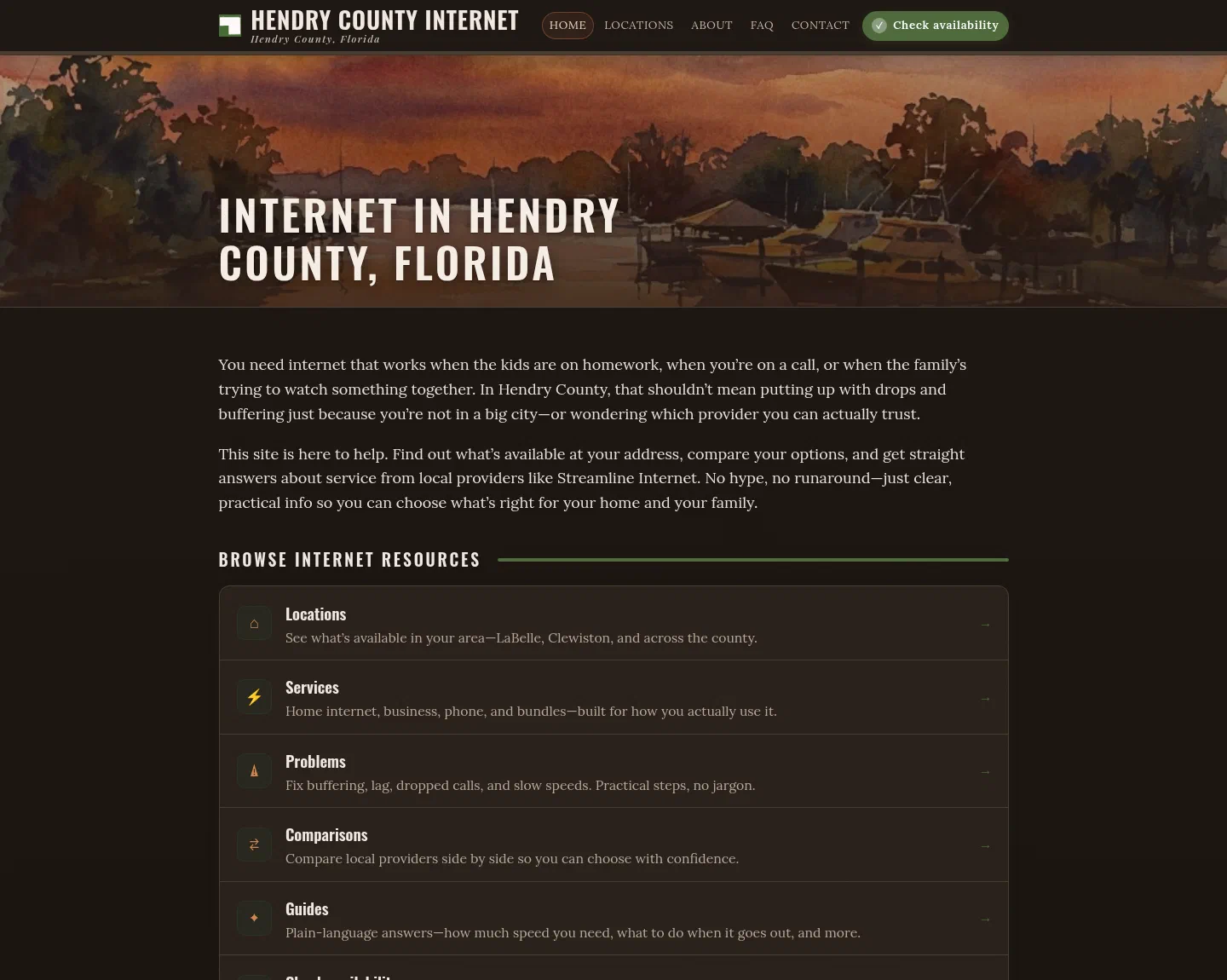
It does not look like a Streamline microsite, which is deliberate. The design came out of what Hendry County actually is: sugar cane and citrus, cattle, canals, Lake Okeechobee, and the families who work the land around it. Cane green, lake blue-gray, soil brown, a warm clay accent, a steady serif, and a watercolor of the river at sunset. Quiet, warm, and not trying to sell anything on first contact.
Ninety-two pages sit behind that homepage, and each one answers a question somebody really asks. The guides handle the plain ones: how much speed a household actually needs, what ping means, where to put a router, what to do the minute service drops. Problem pages take the symptom the way a person would say it out loud, so there are pages for buffering, for lag, for the connection dropping, for Zoom freezing, for no signal in the back bedroom, for weather knocking everything out. Comparison pages set the local provider beside AT&T, CenturyLink, HughesNet, Starlink, T-Mobile, Verizon, and Xfinity. Then most of it exists again at the town level, so somebody searching about a problem in LaBelle lands on a page about that problem in LaBelle rather than a generic one.
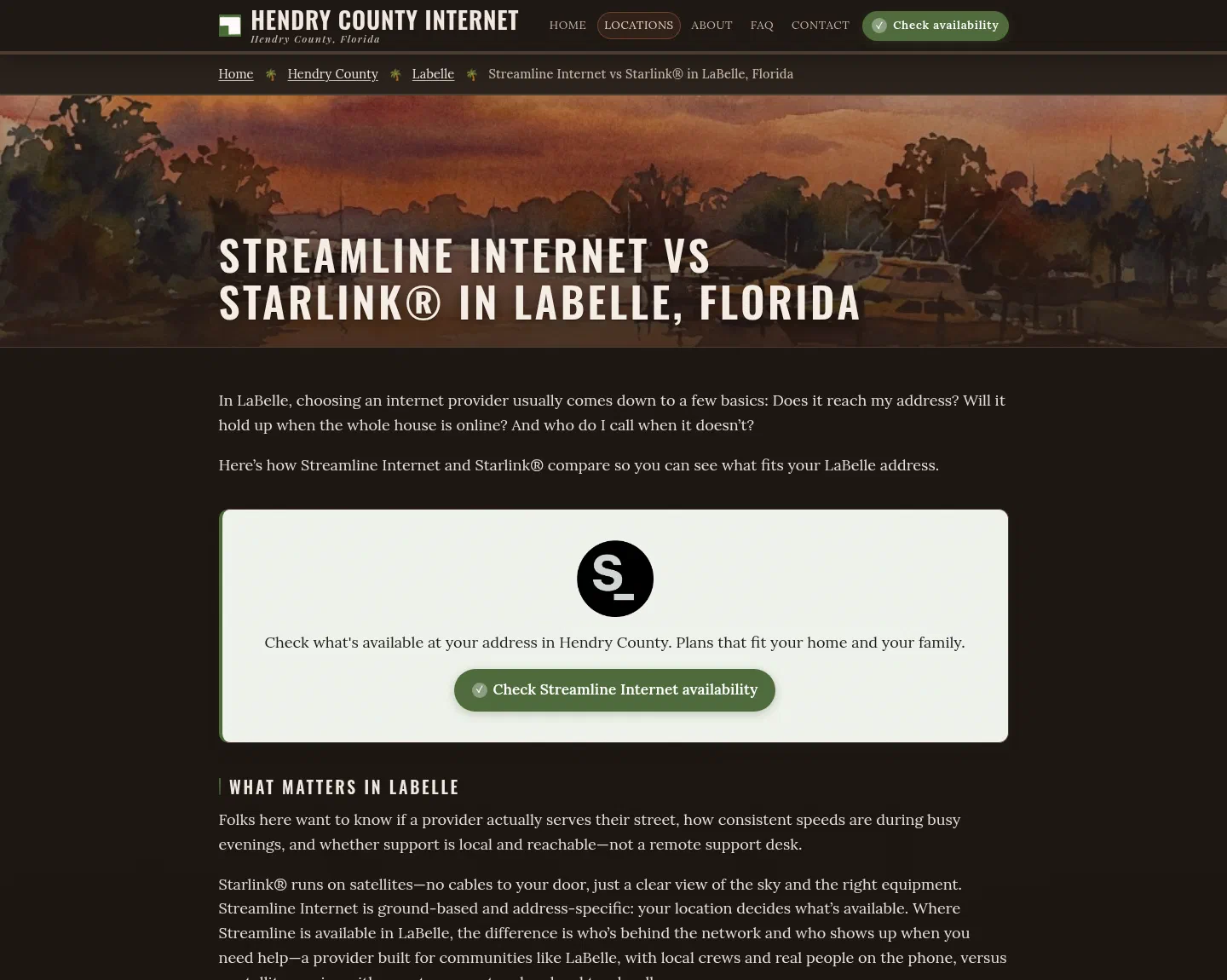
Every page leaves a door open. The invitation on each one speaks to the page it sits on, naming the problem the reader came in with or the town they live in, and it leads to a check that tells them what is available at their address. The pages are also marked up so that search engines, and increasingly the AI assistants people now ask instead of searching, can work out who serves this county and what they are like.
A single site trying to be both the salesman and the encyclopedia tends to do neither job well. Split in two, the county guide earns trust with people who are not shopping yet, and the main site closes the ones who are. Awareness builds on one domain, orders land on the other, and both keep growing. The same pattern travels to the next market a provider enters.
Streamline Scout, in the palm of the county
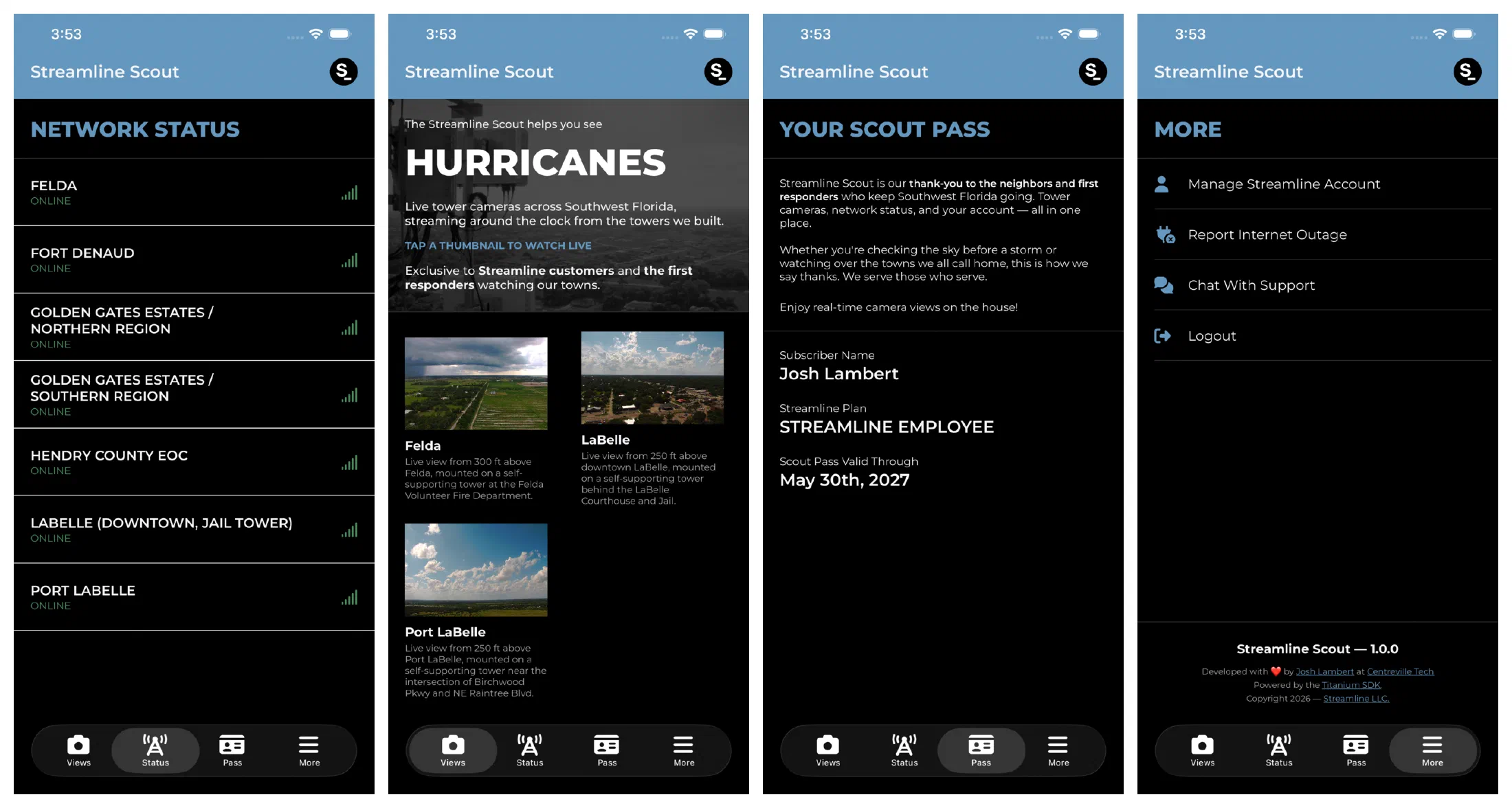
A provider that shows up once a month as a bill is easy enough to leave when somebody knocks with a cheaper offer. Streamline Scout was built to give customers a reason to open the app in between, free with service, live on the App Store and Google Play since June. It runs on Titanium SDK, the open source framework stewarded by the TiDev foundation where I serve as chairman, so one small team keeps the iPhone and Android versions moving together. The same white-label tower camera app now ships for other providers under their own brand.
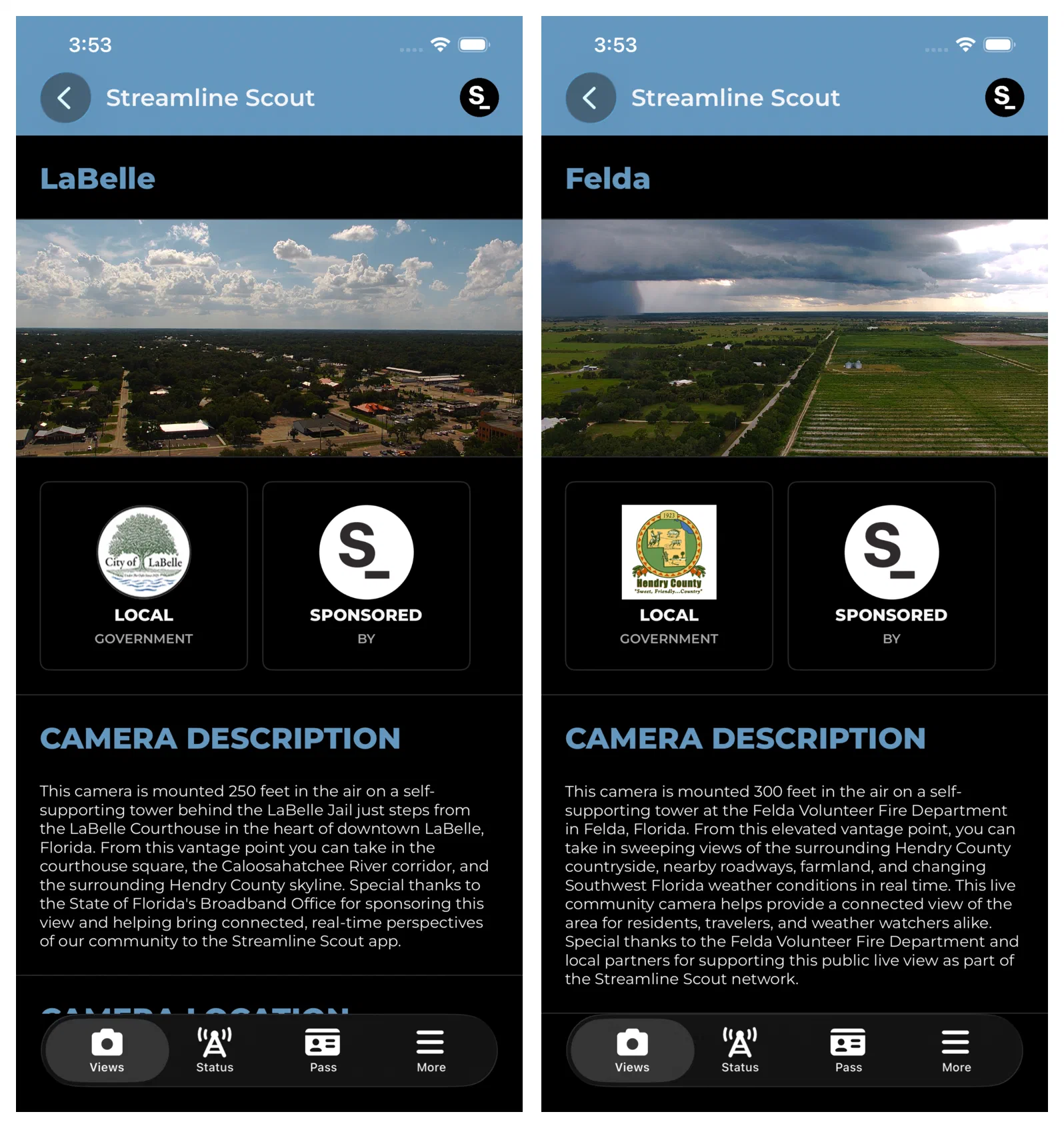
The cameras are the reason people download it. Streamline already owns the high ground, so cameras went up on it. Felda looks out from three hundred feet above the volunteer fire department. LaBelle takes in the courthouse square and the Caloosahatchee corridor from the tower behind the courthouse. Port LaBelle watches the flat country north of town. In a county that spends five months a year with one eye on the sky, a live view of the horizon earns its place on the home screen.
Network status is the less glamorous half and probably the more valuable one. Every site is listed with its current state, the Hendry County Emergency Operations Center among them. When something goes down, the customer sees it before they dial, and what they see is a company that already knows. Providers lose far more goodwill to silence during an outage than to the outage itself.
The rest is ordinary and necessary. A Scout Pass marks the holder as a customer or a first responder. Reporting an outage, reaching a real person in chat, and getting into the account are each one tap away, which is roughly the whole difference between an app people keep and an app people delete.
The social presence around it
A website and an app are places people arrive. Social is the part that goes out and finds them, and in a county this size that means Facebook first, Instagram second, and a voice that sounds like a neighbor rather than a carrier.
The steady work is unglamorous: a content calendar, graphics that look like the brand, replies to comments written by an actual person, reviews encouraged rather than begged for, and outage and maintenance news posted while it is still news. When a storm takes a site down, a post within the hour buys more goodwill than a month of promoted content, because it tells the county that somebody is awake and paying attention.
The campaign side is where the discipline shows. Ads run only where Streamline can genuinely serve, which sounds obvious and is routinely gotten wrong, and they get audited weekly instead of at month end, so a campaign that starts wasting money on a Tuesday is caught that week rather than three weeks later. Over the summer that discipline shut down several campaigns that were spending real money and producing no installs, and moved the attention to the two that were working.
Streamline is fixed wireless and the advertising says so plainly, because in Southwest Florida that is the stronger hand. The last mile here travels through the air. Nothing runs down the street and into the yard, so there is nothing for a backhoe to find, nothing strung on poles for a hurricane to drag down, and no road to trench open before a neighborhood gets service back. Every tower carries three independent feeds and sits on battery with generators behind it, which is how the network stays up through the week that takes everybody else down. A good part of the marketing job is telling that story properly, because the incumbents have spent twenty years teaching rural Florida that one particular technology is the only real internet, and out here it is frequently the fragile one.
Can you reach my house?
Every one of those doors leads back to the same question, and it is the one a rural ISP has always answered worst. Coverage on a fixed wireless network is not a polygon and it is certainly not a ZIP code. It is a list of homes with a clear shot at a tower. Meanwhile the neighbor typing into the box has no idea the county calls their road CR 78 while the post office calls it Fort Denaud Road, and a fair share of them will spell LaBelle wrong.
Getting that right turned out to be worth building properly. Roughly twenty thousand serviceable addresses sit behind the availability check, and a sloppy, half-remembered, misspelled address still lands on the right house in a few thousandths of a second.
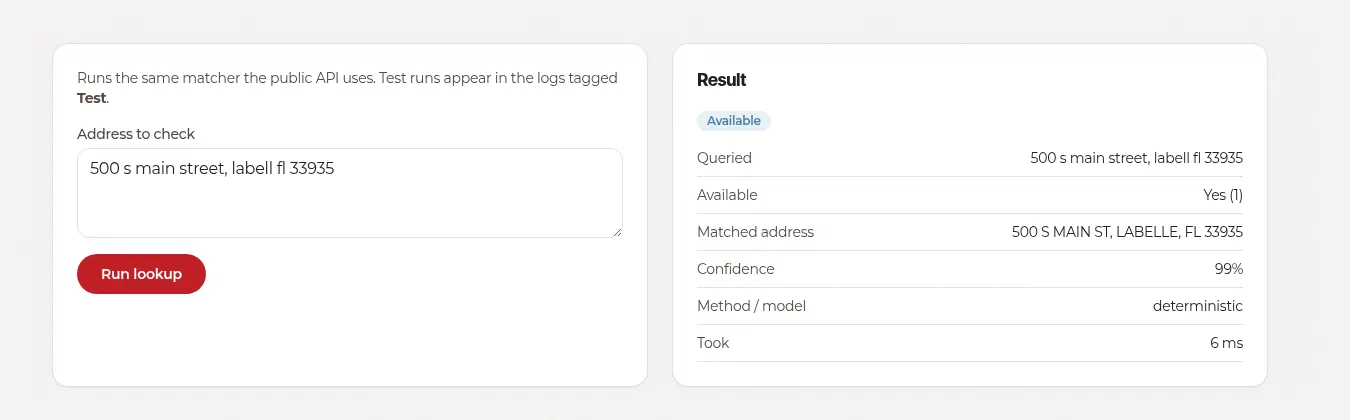
Most lookups never involve AI at all. When one is genuinely ambiguous and a model helps sort it out, the model is still not the authority: whether a house can be served always comes from Streamline’s own records. That distinction is worth the trouble it took, because the alternative is telling somebody yes and then sending a technician to stand in their driveway a week later and take it back. Few things cost a provider a customer faster, and it is a customer they never actually had.
The same answer serves the website, the app, and the county guide, which is the useful thing about building the hard part once.
Why it works better as one engagement
Every piece here leans on another. The order path is only as good as the availability answer underneath it, and that answer is worth getting right because four different front doors all ask the same question. The county guide catches people who are still describing a symptom rather than shopping for a brand, and hands them along when they are ready. The app gives the social feed something worth following, and the feed sends people back to the site. Knowing where each customer came from closes the loop, so the advertising gets judged on installs instead of clicks.
Split that work across three vendors and the seams show up in the customer’s experience. Kept together, a small ISP in a county most people only drive through ends up running a marketing operation well out of proportion to its size.
It also does not stop, which is the part that separates a marketing department from a project. Somebody is in the ad account every week, in the feed most days, and in the codebase whenever the network reaches a town it could not reach before. Streamline turns on new sites and the coverage pages, the campaign geography, the county guide, and the app’s tower list all have to follow. Ranking for a town takes months of consistent work rather than one good launch. A build handed over and walked away from starts decaying the day it ships, and everyone in this industry has inherited one of those from a previous agency.
That is the idea behind ISP Hyperdrive: the website, the social, the ad spend, the mobile app, and the local news partnership, run as an ongoing engagement by people who operate a wireless ISP themselves and measure all of it against the cost of winning one more subscriber. Streamline is the proof that it holds together.
If you run a wireless internet provider and you are tired of stitching four vendors into something that almost works, the whole stack is on the ISP Hyperdrive pricing page, sold à la carte or together, month to month, with ad spend billed at cost. Have a look, then send me an email and let’s talk about your market.