Out past Durango the San Juans fall away into mesa country, and the sky at night still gets properly dark. This is the Four Corners, where Colorado meets Utah, Arizona, and New Mexico, and it is Nimbus Solutions’ country. Mancos, Cortez, Dolores, Lewis, Dove Creek, Hesperus, and the canyon and ranch land between them, a landscape the national carriers have always found easier to admire than to serve. Nimbus is a founder-owned fixed wireless provider that has been wiring it since 2017. Michael Halls was born in Durango, with family roots around Mancos going back a century, and his first tower site was a barn on his great-uncle’s ranch in Webber Canyon. Nine years later the company runs its own licensed LTE and 5G network on Nokia radios, its own autonomous system, and a string of solar-powered mountain sites, some of which were hauled up game trails on someone’s back, one panel at a time.
Word of mouth built most of that, while the website stayed a four-page brochure that said almost nothing about a company with an unusual amount to say. This June Nimbus brought us in to fix it, and the engagement became the full stack: research, a new brand, a new website that folds in Michael’s own coverage map, and paid search run with an operator’s discipline. It is still going, the way this kind of work should.
Reading eight years of newsletters first
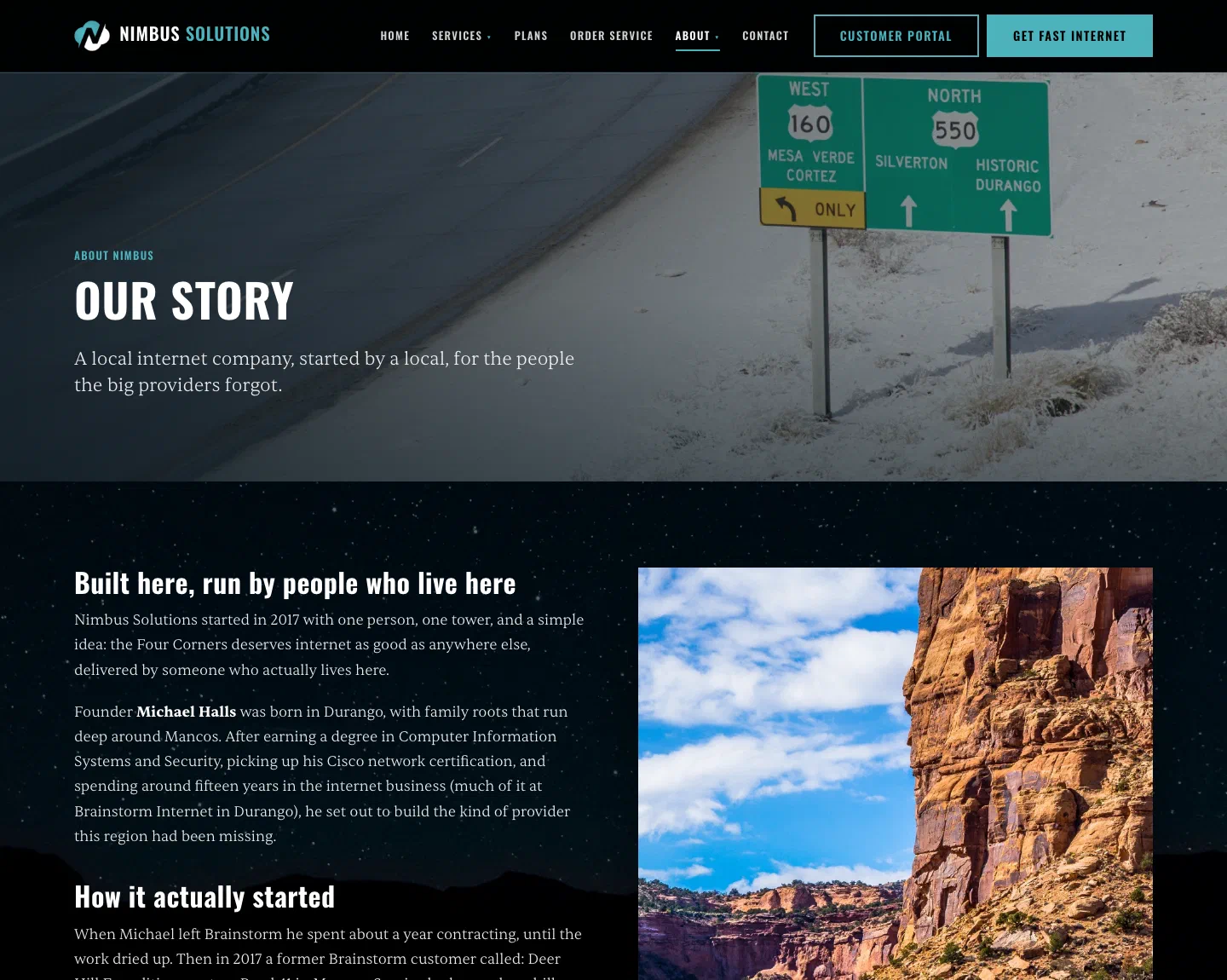
The build started with an export of every newsletter Nimbus had sent since November 2018, 138 of them, and that archive turned out to be a company history nobody had ever assembled: the first customer reached by a point-to-point link across the family ranch, the solar repeater on Temple Hill that carried the first forty customers, the free public WiFi Nimbus stood up in Mancos when COVID sent the schools home. Out of it came a knowledge base with every claim cited to its source, and a page-by-page plan for the new site.
That is why the finished site sounds like Michael instead of like a template. The Our Story page is built from the real history, including the line that stops you: rebuilding abandoned networks in Webber Canyon that he had first built for another company in 2008, Michael says, “Every time I go into Webber, I feel like I’m chasing ghosts.” No agency invents a line like that. It only turns up when somebody reads the archive.
A site the color of a Colorado night
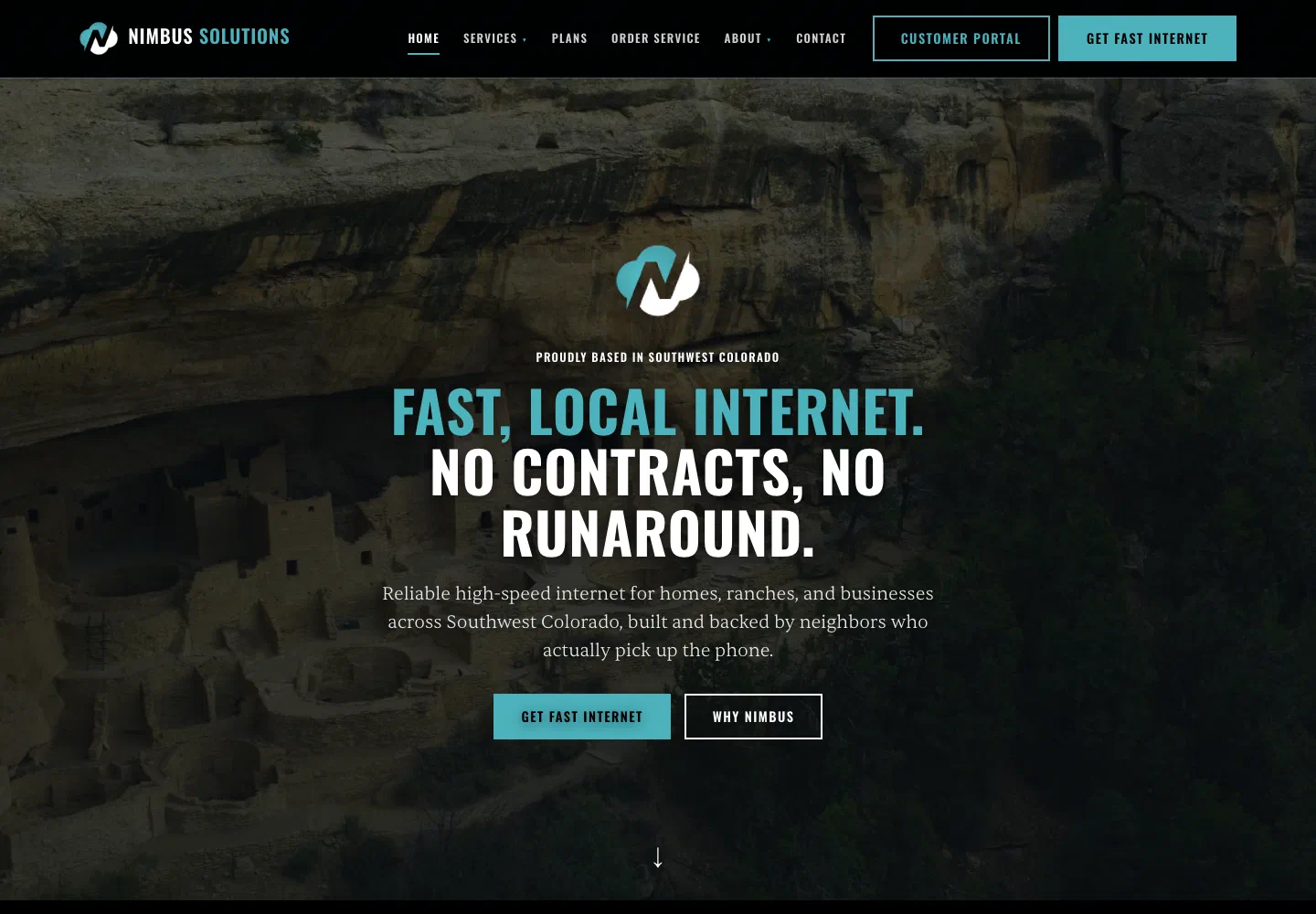
The old brochure got twenty-two pages to replace its four, and a brand worth keeping. The design came out of what the Four Corners actually looks like after sunset: a black page over a real night-sky photograph, one teal accent and nothing else, square corners, a tall condensed face for headings and a serif for the body. The spec lives at a living style-guide page with a machine-readable twin, so the site can grow for years without drifting. The homepage opens on Mesa Verde and the slogan that carries the whole pitch: fast, local internet, no contracts, no runaround. The copy is aimed at people the company will see at the grocery store, which is why it mentions, plainly, that about 95 percent of support issues get resolved over the phone.
Each of the six towns got a landing page of its own, and each page got a watercolor of that town at night, the Milky Way overhead and the porch lights on. A search for internet in Dolores lands on a page that is unmistakably about Dolores, painted like somewhere you would want to live, rather than on a generic coverage grid.
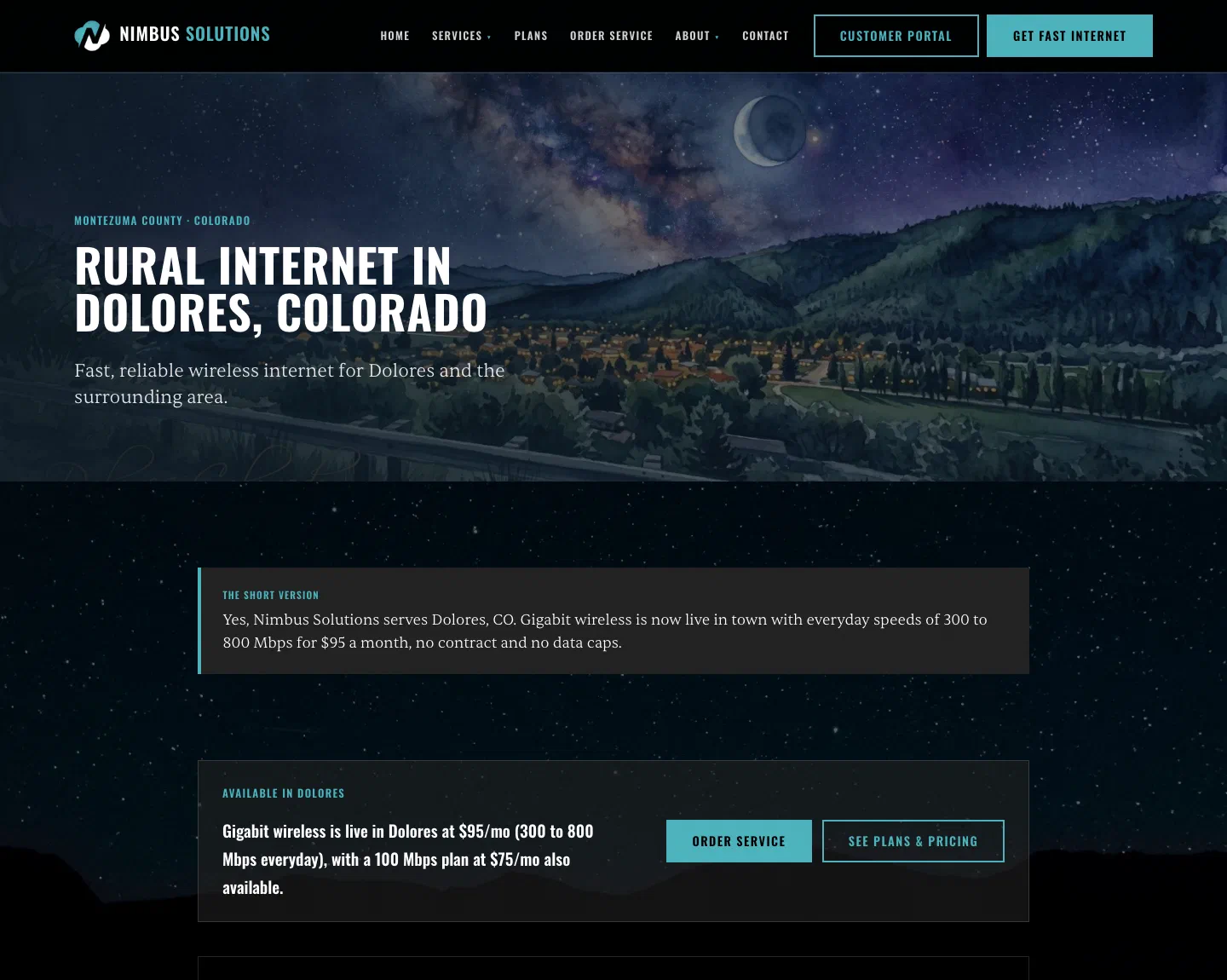
Those town pages are also where the site speaks to machines. Every page opens with a plain-language answer box, carries question-and-answer markup, and the whole site is summarized in a machine-readable digest, because a growing share of “who has internet in Dolores” questions are now asked to an AI assistant rather than typed into a search box. When somebody asks their assistant who serves Montezuma County, Nimbus intends to be the answer with sources.
Prices on park signs, and the fine print in plain English
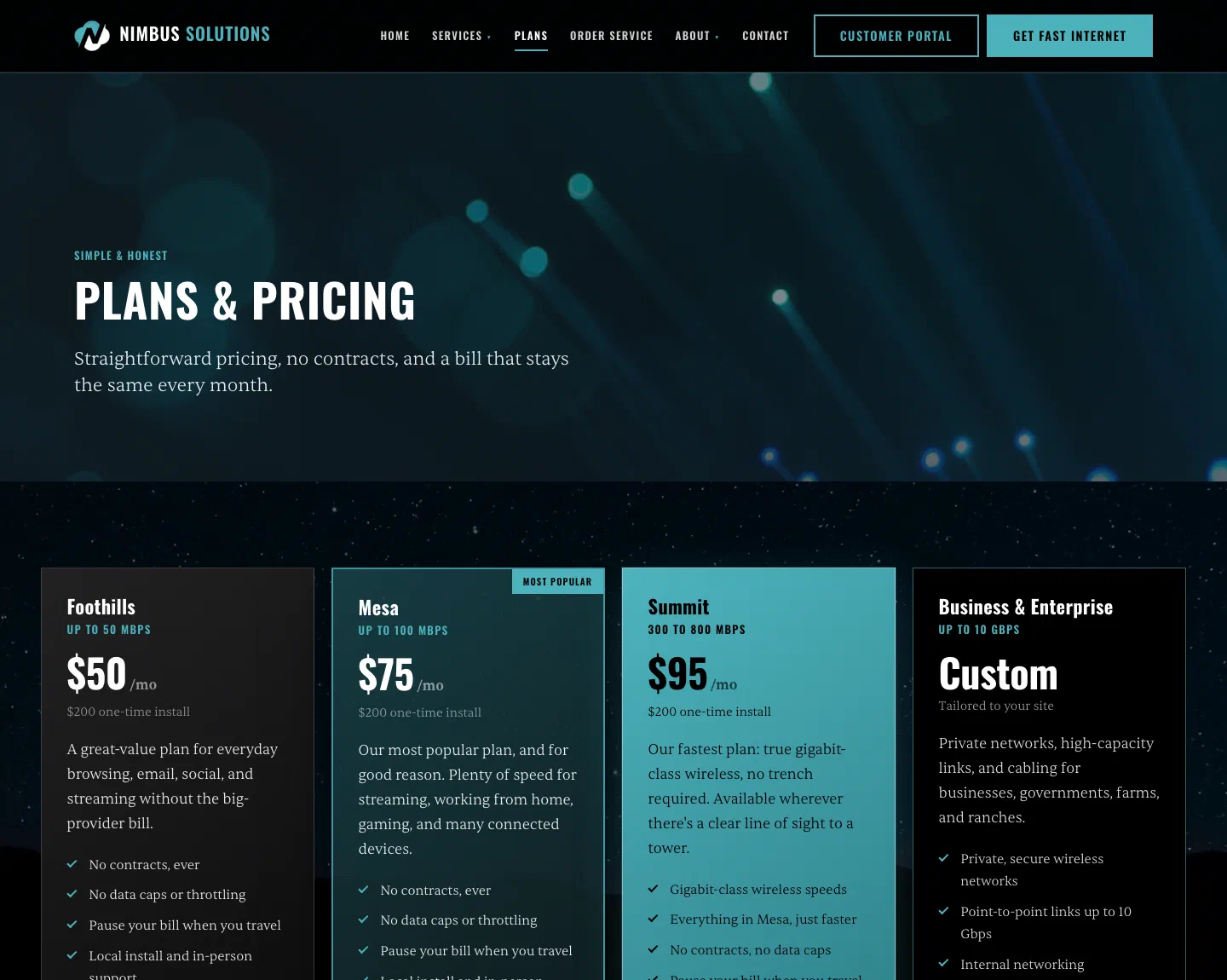
Most rural providers hide their prices behind a quote form. Nimbus publishes everything. The plans are named for the country they serve, Foothills, Mesa, and Summit, and the Summit tier is gigabit-class wireless, 300–800 Mbps, live today in Dolores, Lewis, and Mancos. Out here that last mile travels through the air, and in rural Colorado that is the stronger hand. This is country that breaks buried line: frost heave, washouts, spring storms, and the backhoe that never called 811 all find fiber eventually, and a cut in a canyon can take a valley down for days while somebody digs. Nothing about a wireless link is lying in the ground waiting to be broken. Nimbus matches the performance and skips the failure modes, and the site says so without blinking.
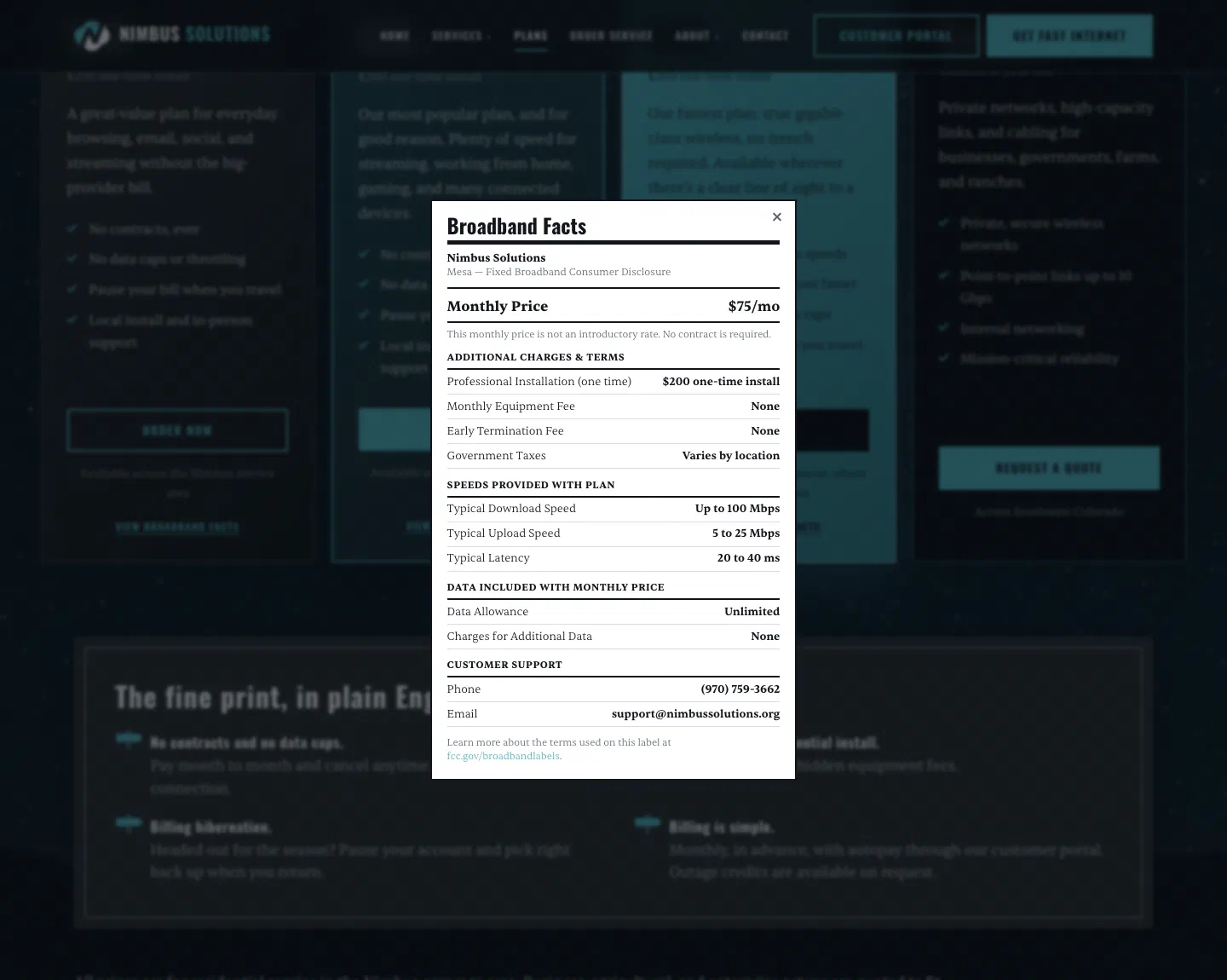
Every plan also carries a proper FCC Broadband Facts label, the nutrition-label disclosure most small providers treat as a nuisance, presented here like it belongs. Below the cards sits a section titled “The fine print, in plain English,” which is exactly what it says. The prices themselves live in one data file that feeds every page that mentions them, so the homepage and the plans page can never drift apart. The same honesty rule covers the homepage testimonials: real Google reviews, quoted word for word, names attached, and the site’s own guidelines forbid editing them.
The map that answers the only question that matters
Every ISP website exists to answer one question: can you reach my house? For a fixed wireless network in canyon country the honest answer depends on terrain, and terrain is exactly what a ZIP-code coverage list throws away. The customer who gets told yes on Monday and no by the installer on Friday is a customer lost for ten years.
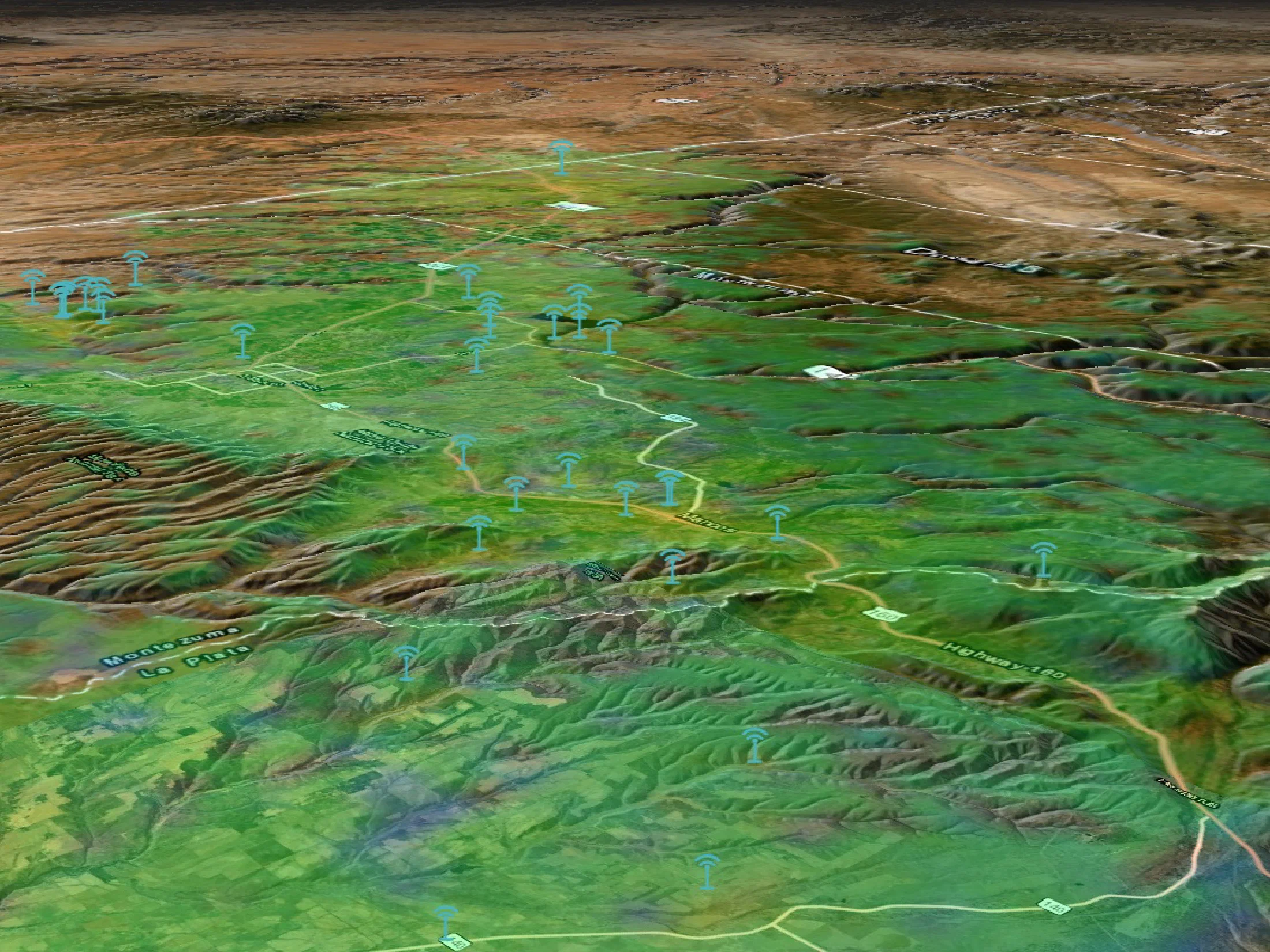
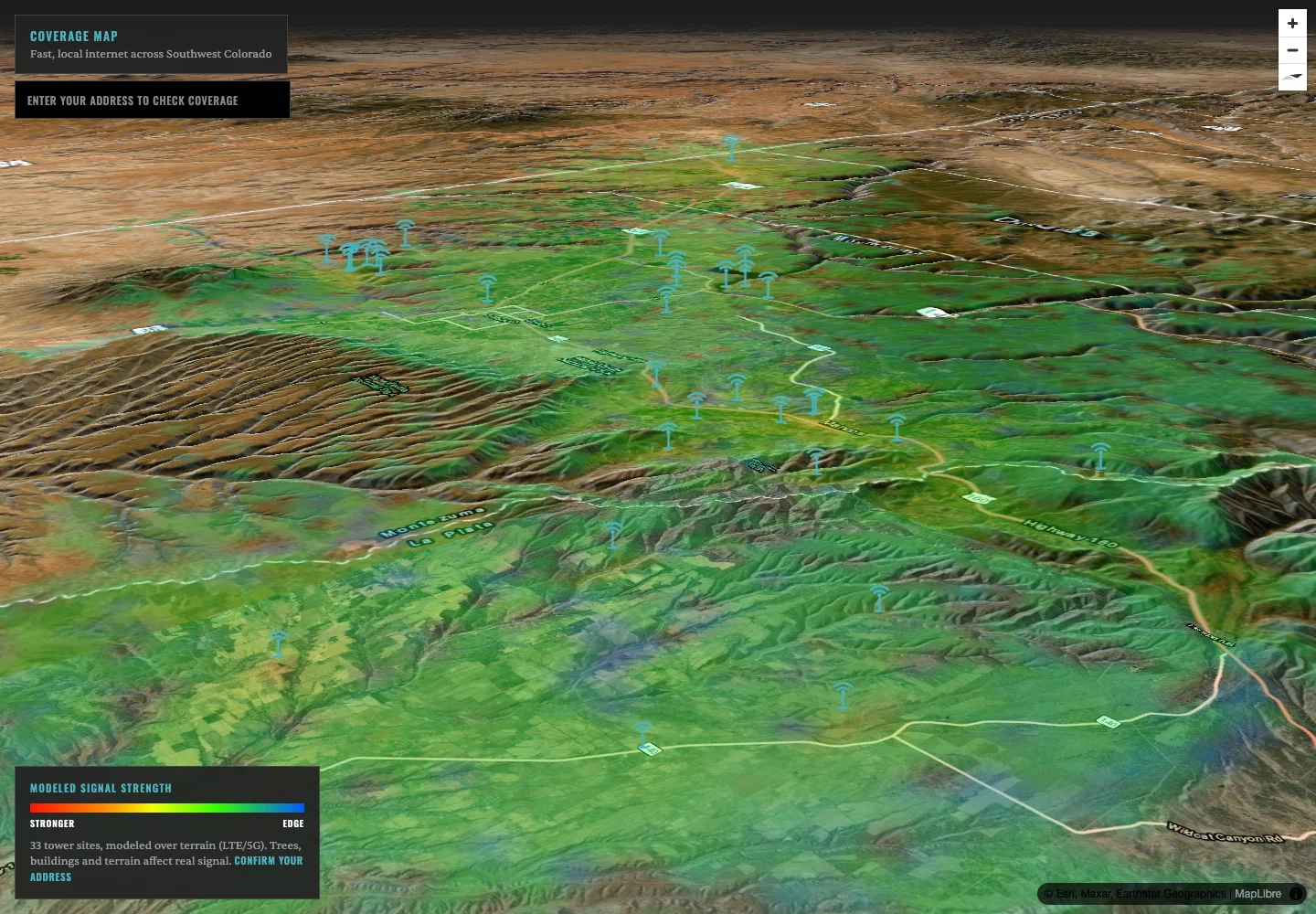
So instead of a static blob on a flat map, the site carries an interactive 3D coverage map, and the map is Michael’s own build. It drapes satellite imagery over real elevation data, marks all 33 tower sites, and overlays radio propagation modeled over that terrain for every one of them, so the coverage you see thins out behind ridgelines the same way the actual signal does. You can tilt the whole Montezuma Valley and watch the modeled signal pool in the places where people actually live. Only the operator of the network could have made this, and it shows.
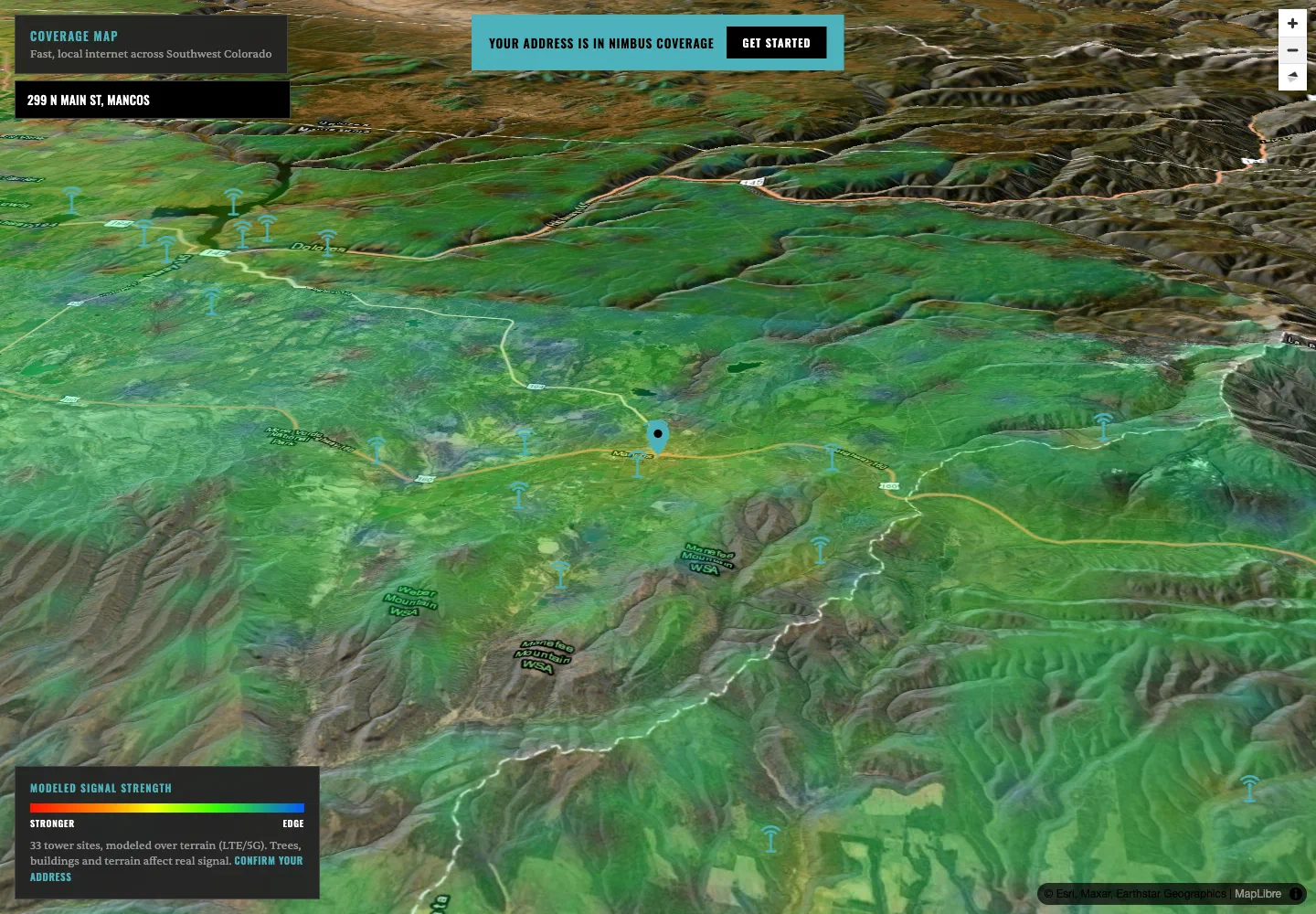
Under the search box sits a county-GIS address index, 58,541 addresses strong, so a resident can start typing and pick their own house from the list. The map flies to the rooftop, checks the point against the modeled coverage, and renders a verdict: in coverage, with a button that carries the address straight into an order, or not yet, with a button that reaches a person instead.
Folding his engineering into our site never felt like a handoff, because there was not one. Michael and our team were linked in a shared Slack group the whole way through, his map and our pages moving together, questions answered in minutes rather than meeting cycles, until the finished site reads like one hand built it. The map now sits on the coverage page and on every town page, tuned to each town, founder-led work in the same key as everything else Nimbus does. No Upwork listing or big-city agency collaborates with a wireless operator at that level; the shared vocabulary alone takes years to earn, and we have it because we run a WISP ourselves.
Ads drawn inside the coverage line
Two days after the site settled, six tightly scoped Google Search campaigns went live: brand terms, the core towns, the wider footprint, the competitors, the business track, and the agricultural work that makes Nimbus unusual among WISPs. The discipline matters more than the launch. Ads run only inside geography Nimbus can genuinely serve, drawn as circles around real coverage rather than county lines, and the copy obeys the same brand rules as the site, so the word gigabit appears only where gigabit is actually sold. Conversion tracking was wired through before the first dollar was spent, phone calls included, and the account gets audited against a written changelog rather than a monthly glance. Inside the first two weeks the tracking was already attributing conversions to campaigns, and when one sensible-looking search term started burning money at auction, the audit caught it and shut it off. That is the difference between running ads and watching them.
Why it holds together
Each piece makes the others worth more. The research gave the website its voice, and the website gives the ads somewhere worth sending a click. The coverage map keeps the promise the ads make, because nobody gets invited to order at an address the network cannot reach. And the whole thing is instrumented, so the question “did any of this bring in subscribers” gets a real answer instead of a hopeful one. It is also not finished, because networks grow: a new tower changes the map, a new town needs its watercolor, and somebody has to be in the ad account every week. Nimbus runs its network with the same appetite for building, incidentally: the core stack behind those towers includes Rapid5GS, which readers of this site have met before.
This is the work I sell through ISP Hyperdrive, the fractional CMO practice for wireless internet providers: the website, the research, the advertising, and the ongoing care, measured against the cost of winning one more subscriber. Streamline Internet was the first full engagement; Nimbus is the proof it travels. If you run a wireless provider whose website undersells the network behind it, the whole stack is on the pricing page, month to month, à la carte or together. Have a look, then send me an email and tell me about your market.