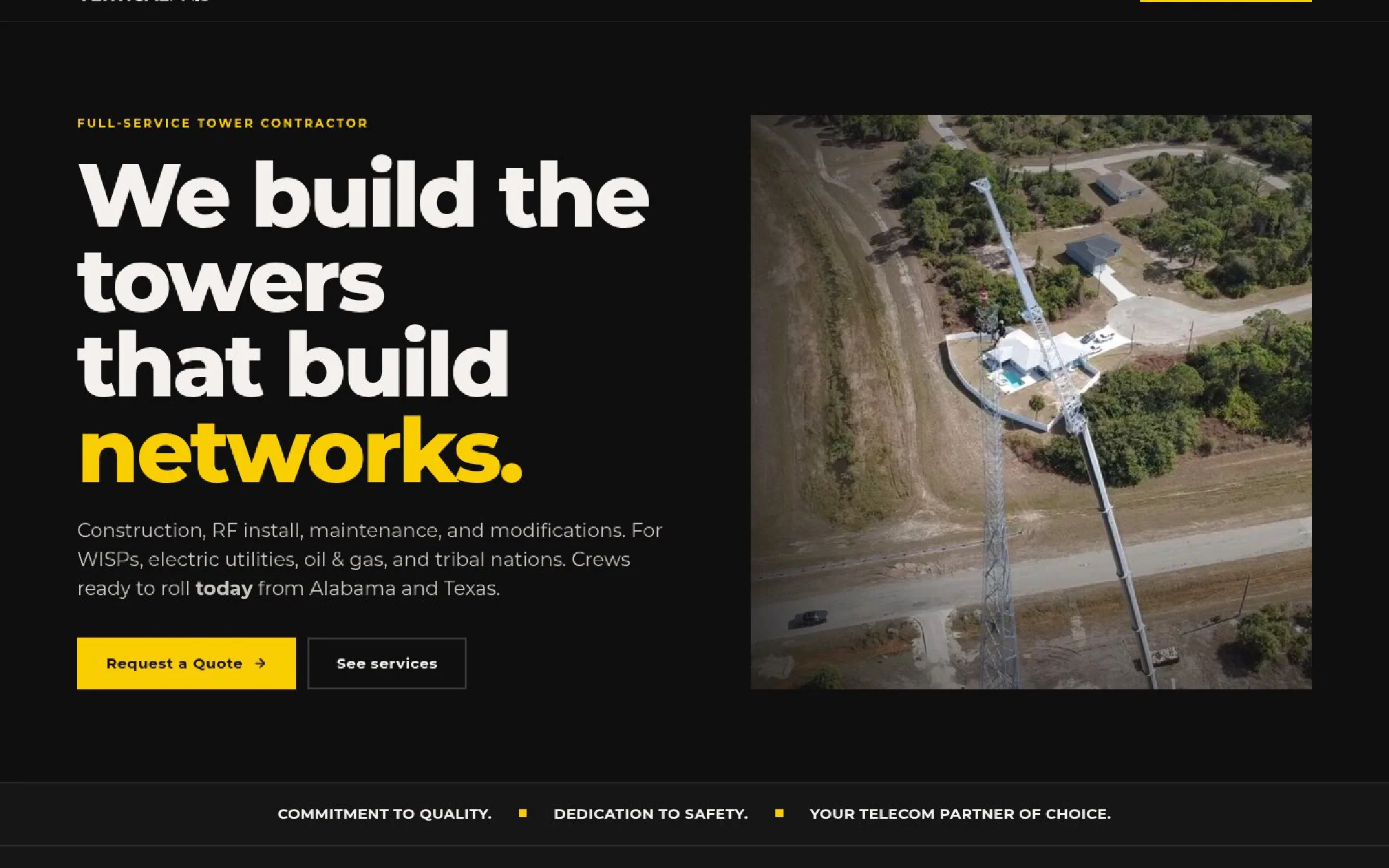
Tower work has always been sold in hallways. An operator at a trade show gets a name from the fellow two counties over, writes a number on the back of a card, and calls it fourteen months later when the grant money lands. That is how Vertical Axis has been hired since 2018, and it worked: better than three hundred wireless providers by the company’s own count, thousands of sites, crews in Alabama and Texas, one project standing 690 feet in the air.
The trouble with a hallway is that only so many people fit in it, and none of them are the county emergency manager three states away with money and a coverage gap. In 2019 he would have asked around. This year he opens an assistant and types something close to: who can build a 300-foot self-support tower in west Texas and do the radio install. Whatever comes back is his shortlist, and there is a fair chance he never sees a page of search results at all. An answer engine cannot repeat a conversation it was not in, and a company that has never written down what it does is, to that machine, a company that does not do anything. Vertical Axis had eight years of work behind it and a Facebook page in front of it.
Specific enough to be quoted
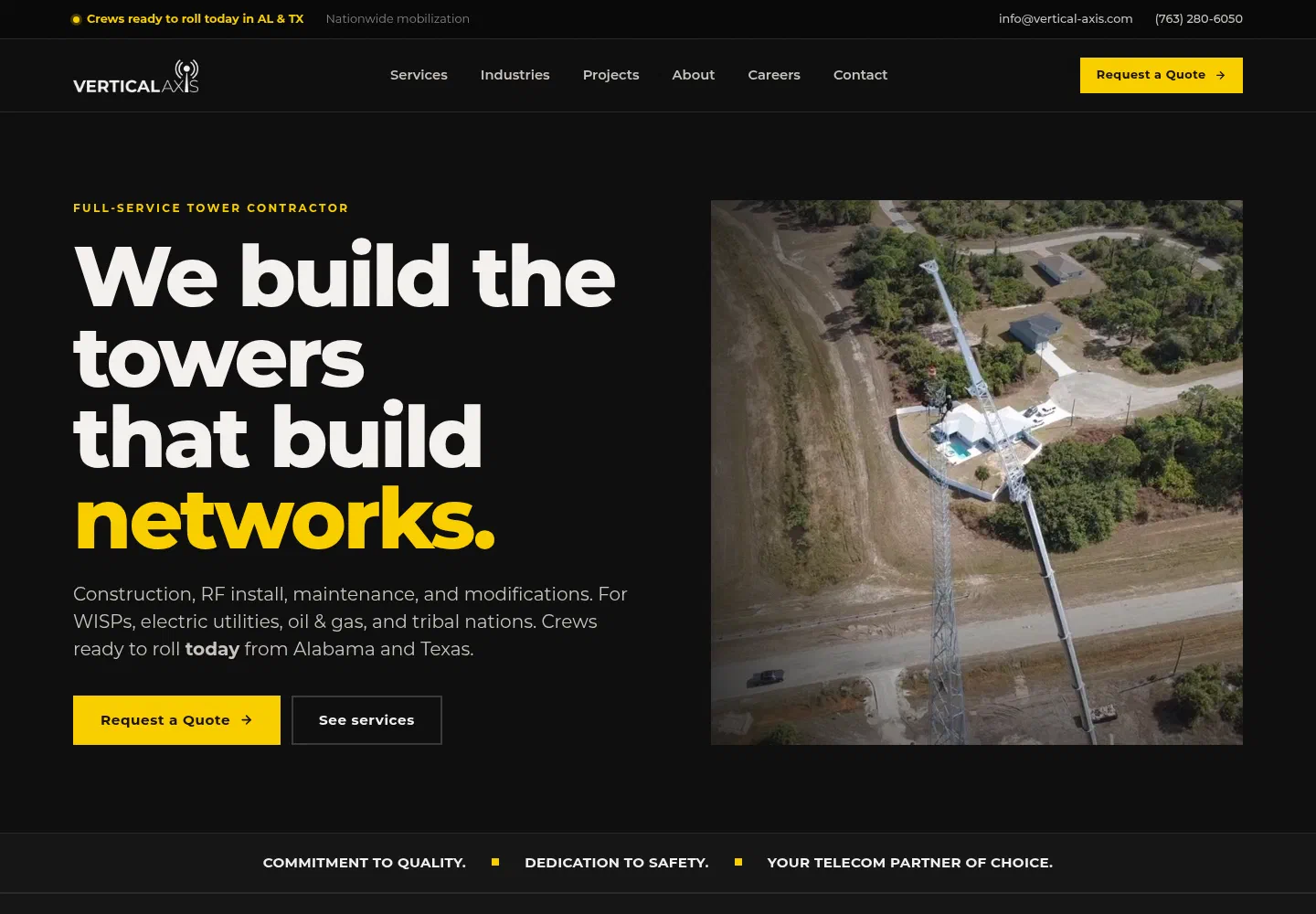
Nothing vague ever gets quoted. “Full-service tower solutions from the ground up” is on a banner in every booth at the show, and it is worth nothing to a machine answering a real question, because it matches everybody and therefore nobody.
So the first weeks went into pinning down what is actually true, and the corrections ran in an unexpected direction. Marketing copy drifts upward on its own, and every claim we drafted came back from CEO Kelly Zacrep smaller. The lasers went first. “Bringing the lasers out is last ditch effort,” Kelly said, so laser alignment stopped being advertised and the total station took its place. There is no sweep analyzer in the trucks, so VSWR is now described as a check through the radio’s own diagnostics. No OTDRs, so fiber verification is a light source and power meter. No spectrum analyzers, no yard, and no licensed RF engineers on staff, so the site design page says a partner firm is brought in when a stamp is required.
None of that makes the company sound bigger. All of it is why the company can be cited. A false claim is worse than a vague one, because the machine will repeat it right up to the site walk where it falls apart, and getting vouched for and then disqualified is how you lose a customer you never had.
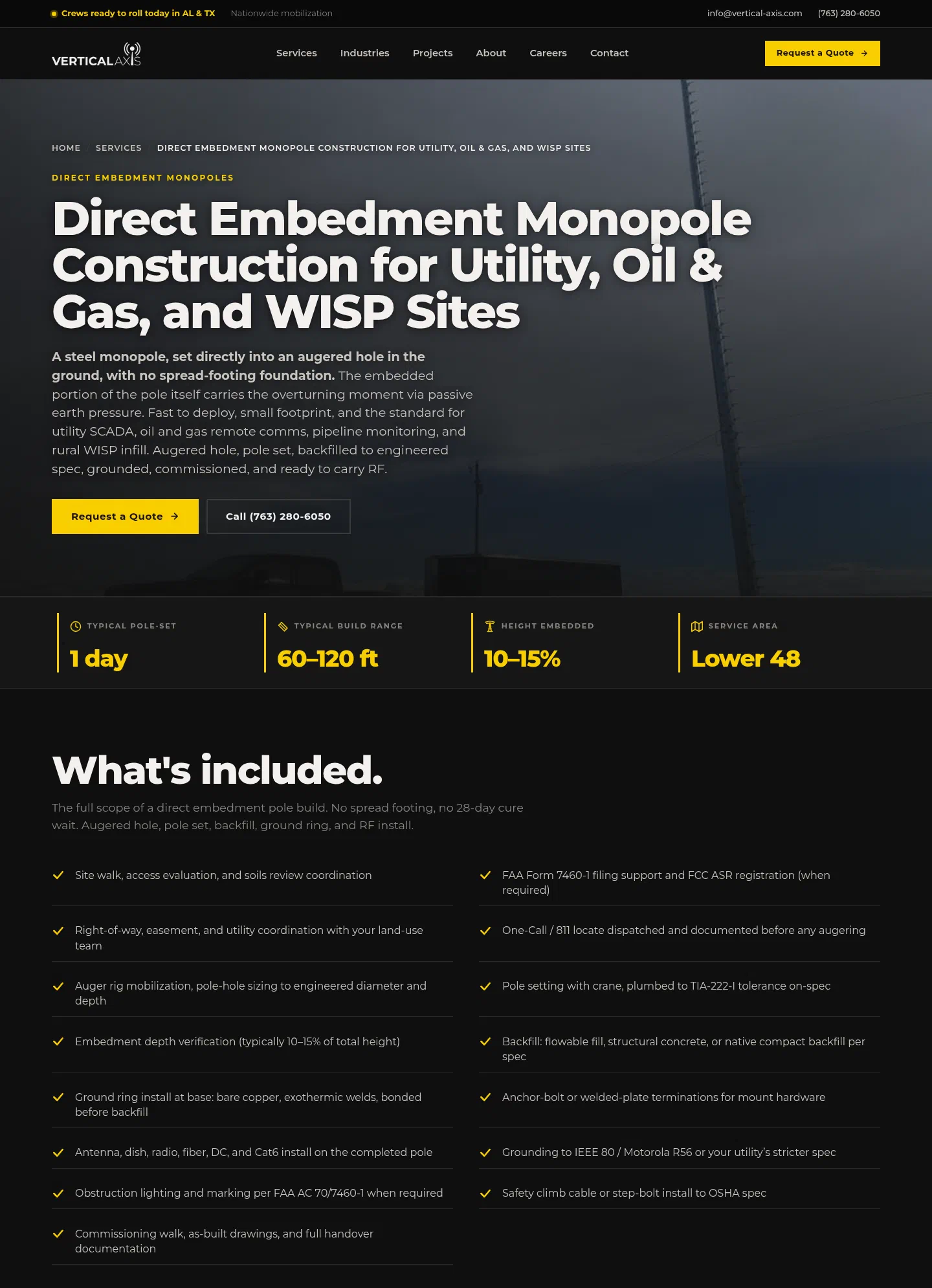
What replaced the banner language sounds like a foreman talking. A direct embedment monopole has no spread footing: the embedded steel, ten to fifteen percent of the pole’s height, carries the overturning moment through passive earth pressure. Which matters for one reason, and the page leads with it. Four to six weeks of foundation and cure becomes one to three days from auger rig to backfill. Across fifty sites on a grant schedule, that moves somebody’s whole program up a season. Fifteen service pages were written to that standard.
Nobody searches for a tower contractor
Buyers do not search for what a vendor sells. They search for what is wrong with their own week, and the words differ in every corner of this market. A utility manager is thinking about SCADA backhaul and grounding spec. A county is thinking about a 4.9 GHz ring. A tribal broadband office is thinking about NTIA deliverables and reporting deadlines. A WISP owner is thinking about margins, and about not being billed carrier rates to hang prosumer gear.
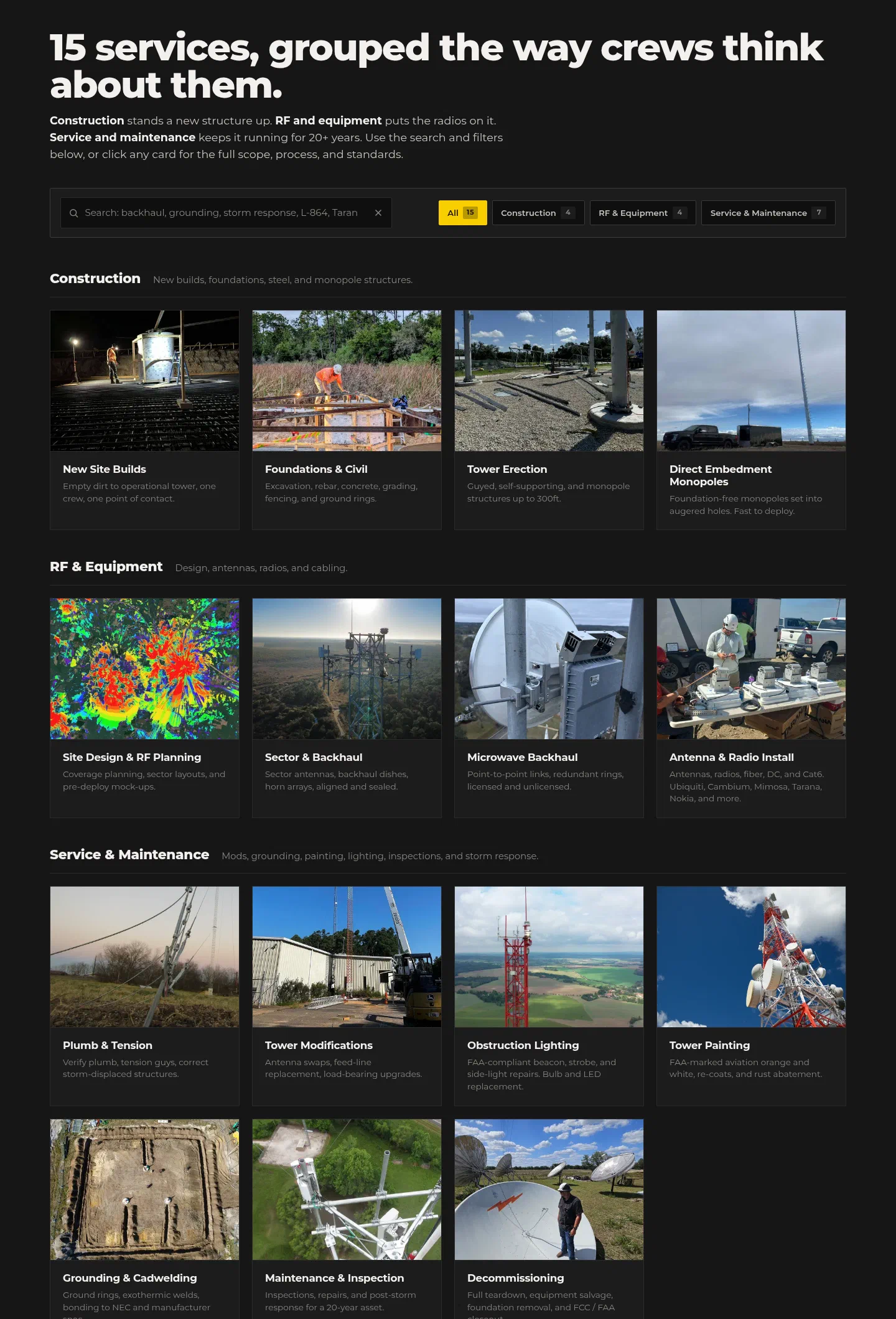
So the site is two grids that cross. Fifteen services describe the work the way a crew divides it; six industry pages describe the same company in each buyer’s vocabulary, linked to each other in both directions. Oil and gas, public safety, tribal nations, and municipal broadband are not one template four times. They are the same trade explained to four people who would not recognize each other’s terminology.
Underneath sits the real unit of getting found, which is not the page but the answered question. There are 378 of them: how long it takes, what happens when the soil is wrong, who files the FAA paperwork, what a change order actually covers. A buyer comparing contractors is compiling a list of worries, and whoever answered the fourth one in writing wins before the call. An assistant does the same thing, faster.
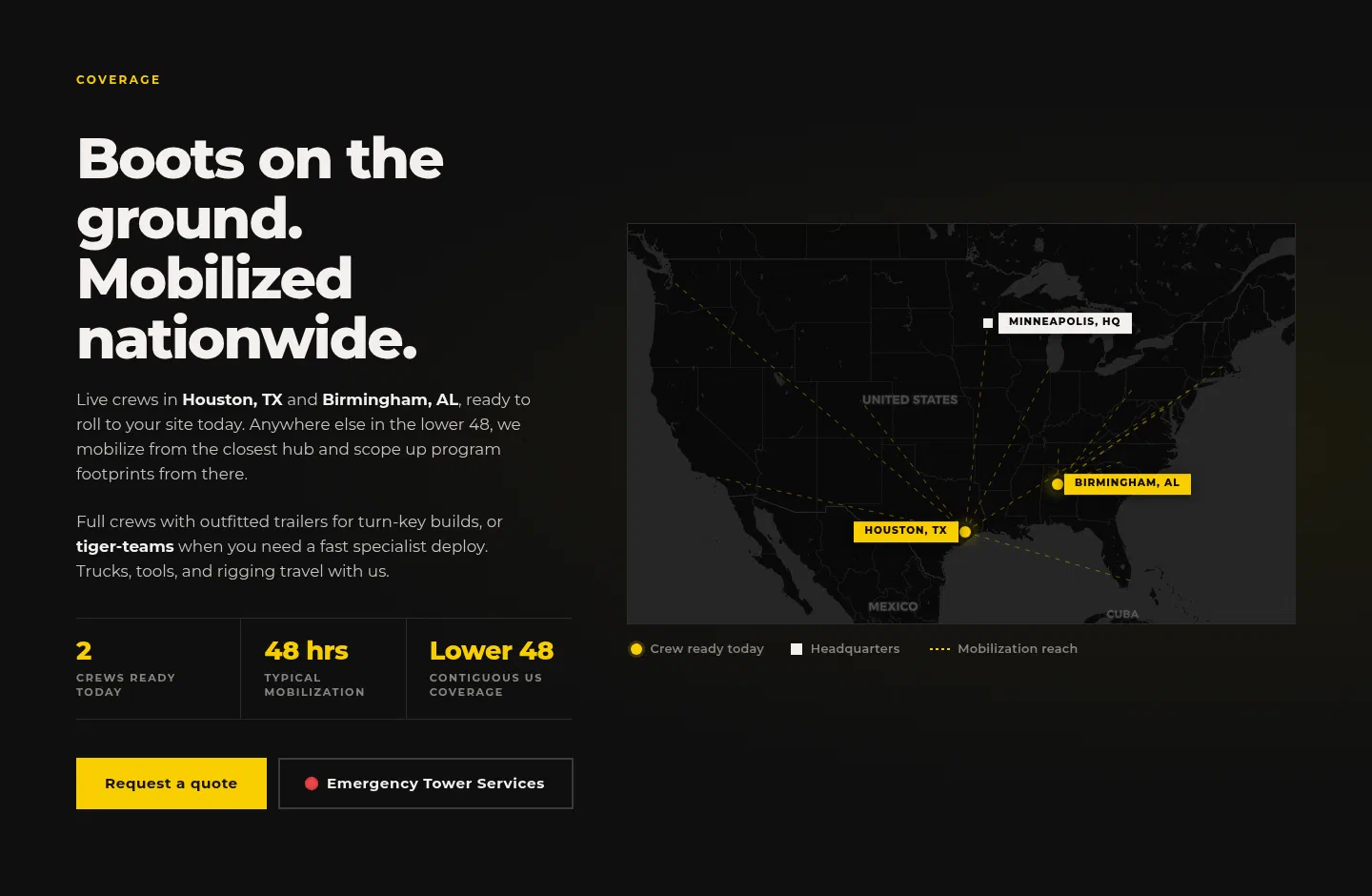
Two questions arrive on their own schedule. Whether anybody comes out this far, which the service area page answers with a map and three crew hubs, and the one asked at four in the morning by somebody whose tower is down, where the emergency page draws a line most contractors blur: take your place in the queue, or hold a retainer and have a rigged climber guaranteed on site inside four, twelve, or twenty-four hours.
Proof a stranger can check
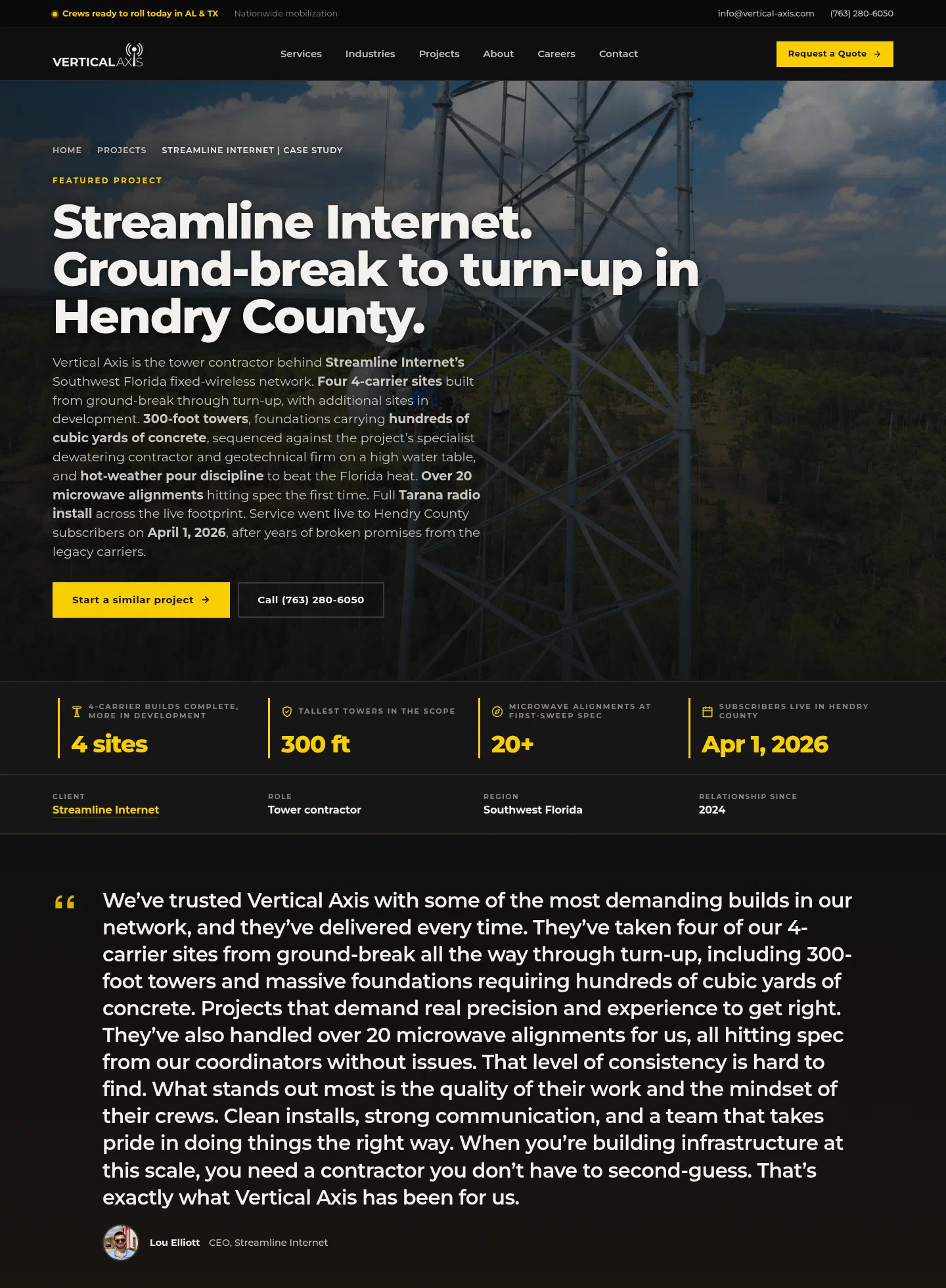
Specific claims invite the obvious question, so two projects were written up with dates, counties, and quantities. The Streamline Internet buildout in Hendry County, Florida is the better story because the interesting parts never appear on a drawing. A high water table meant well points running from a week before ground-break until the foundations were backfilled, with every dig and pour sequenced against the dewatering contractor’s schedule. Florida summer meant rebar tied the day before, trucks rolling at first light, and wet cure held through the afternoon so the concrete would still make strength at twenty-eight days. Then more than twenty microwave alignments, every one clearing the path coordinator on the first sweep with no re-climbs. Service reached subscribers on the first of April. Readers here have met that network from the other side, in Streamline’s marketing engagement.
The other, Alabama Lightwave, runs back to 2018 across three central Alabama counties. In the interest of plain dealing, that is my own company and the testimonial is mine, which is why the page leans on dates and equipment rather than the compliment.
The names are the product
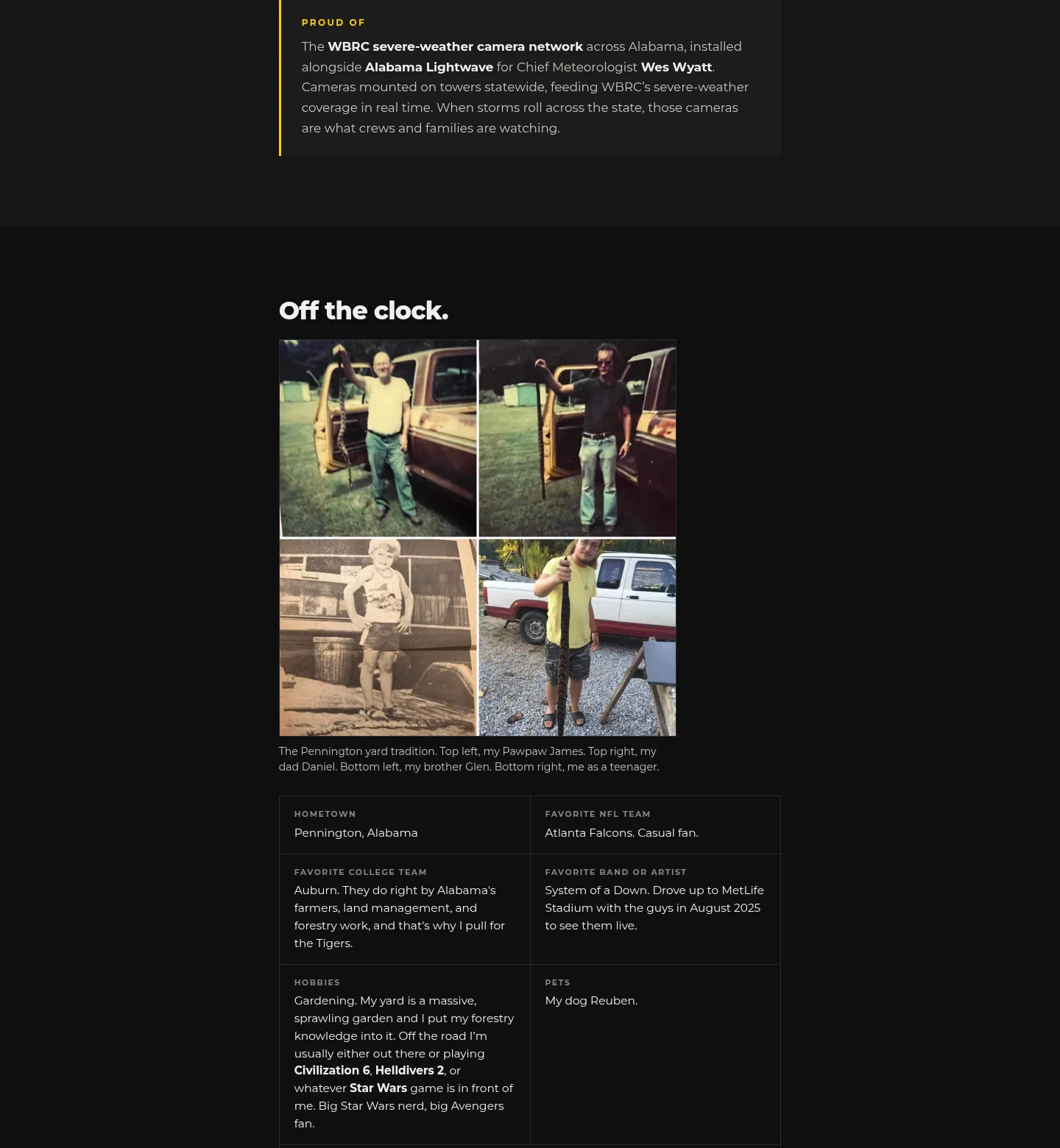
Blue-collar businesses are bought on people, and an anonymous crew is unciteable the same way a vague claim is. Tommy Waldrop founded the company in 2018, climbed his first tower at thirteen, came up through his brother’s WISP in West Alabama, and has since handed over the seat and stepped out of operations. Kelly Zacrep runs it today. His page is history rather than a promise about who answers the phone, down to the photograph of four generations of Waldrops posing with snakes beside old trucks in the yard at Pennington, and his niece Ryanna’s account of the childhood behind it: “house rule was after breakfast, you go outside. You can come back in for water or lunch, and then you go back outside until supper time.”
Not a word of that ranks for a keyword, and all of it is why somebody picks up the phone. The same treatment goes to the crew running the work now, on the team page, and the careers page is aimed at climbers and civil hands, who are the scarcest resource in this trade and who also search.
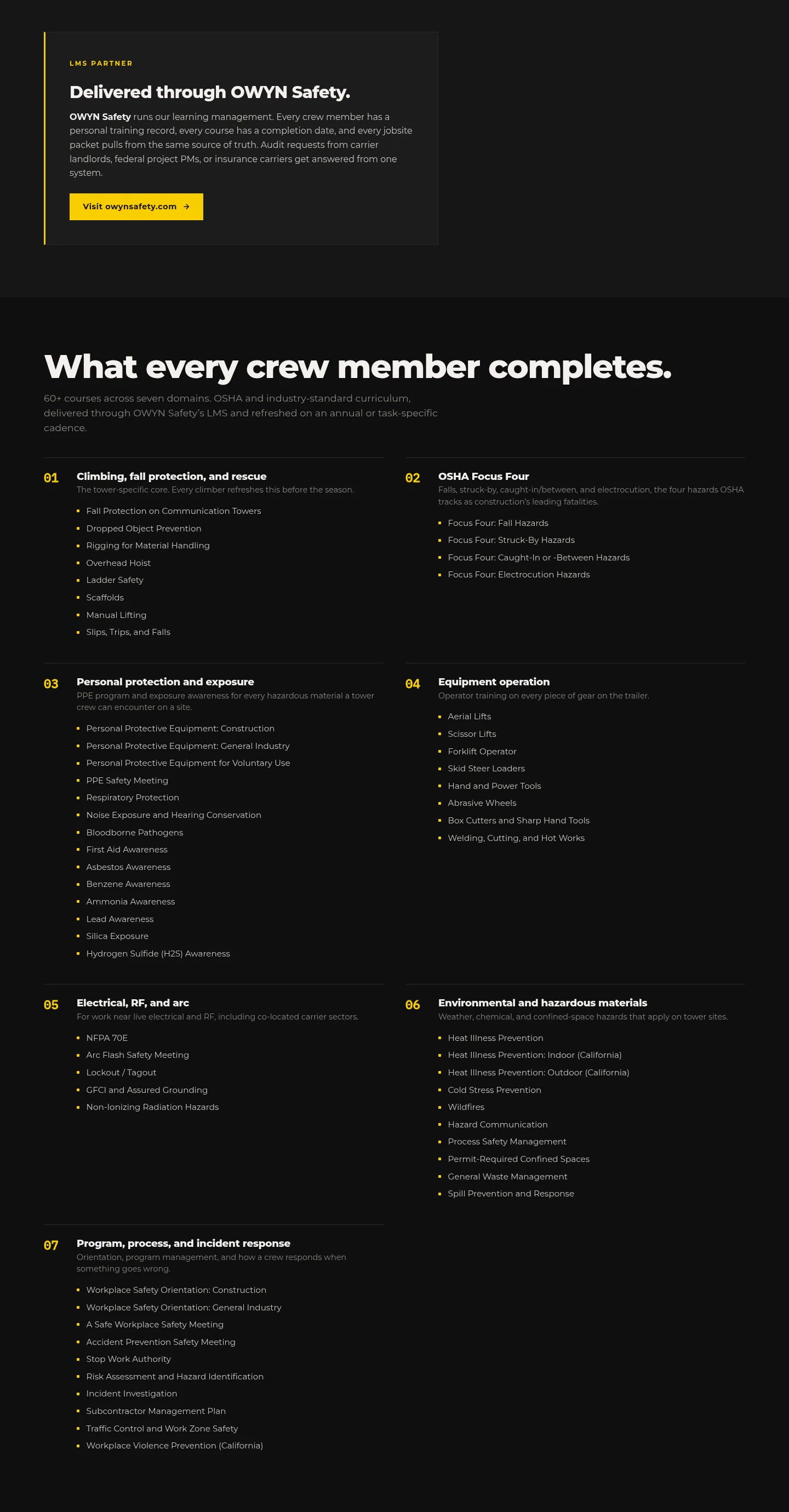
One more page exists for the same reason. Carrier landlords will not clear a crew to climb without a current safety packet, so the safety program publishes the whole catalog, sixty-odd courses a year through OWYN Safety, every course named. What used to be a form somebody had to request is a page they can read at midnight while deciding whom to shortlist.
The plumbing is the cheap part
Structured data goes out on every page. An llms.txt index and a full-text companion let an assistant ground an answer in whole pages instead of scraps. The robots file names the citation crawlers instead of leaving them to guess. Page dates come from version history rather than a hand-typed field, so the freshness signals stay true with nobody maintaining them. Separate inboxes keep a quote, a question, and a job application out of the same pile, and first-touch attribution rides into the lead, so a year from now “did any of this work” has a project name on it.
All of that took a fraction of the effort the writing did, and it is the part everyone selling GEO wants to talk about. Markup does not make a claim true, it only makes a claim legible. Perfect JSON-LD wrapped around a banner slogan is a beautifully labeled box with nothing in it.
What came back
The site went up this spring and the citation work landed in the middle of July. Below is where things stand at the end of July, which is a snapshot rather than a standing claim, because results move with the week, the wording, and whoever is asking.
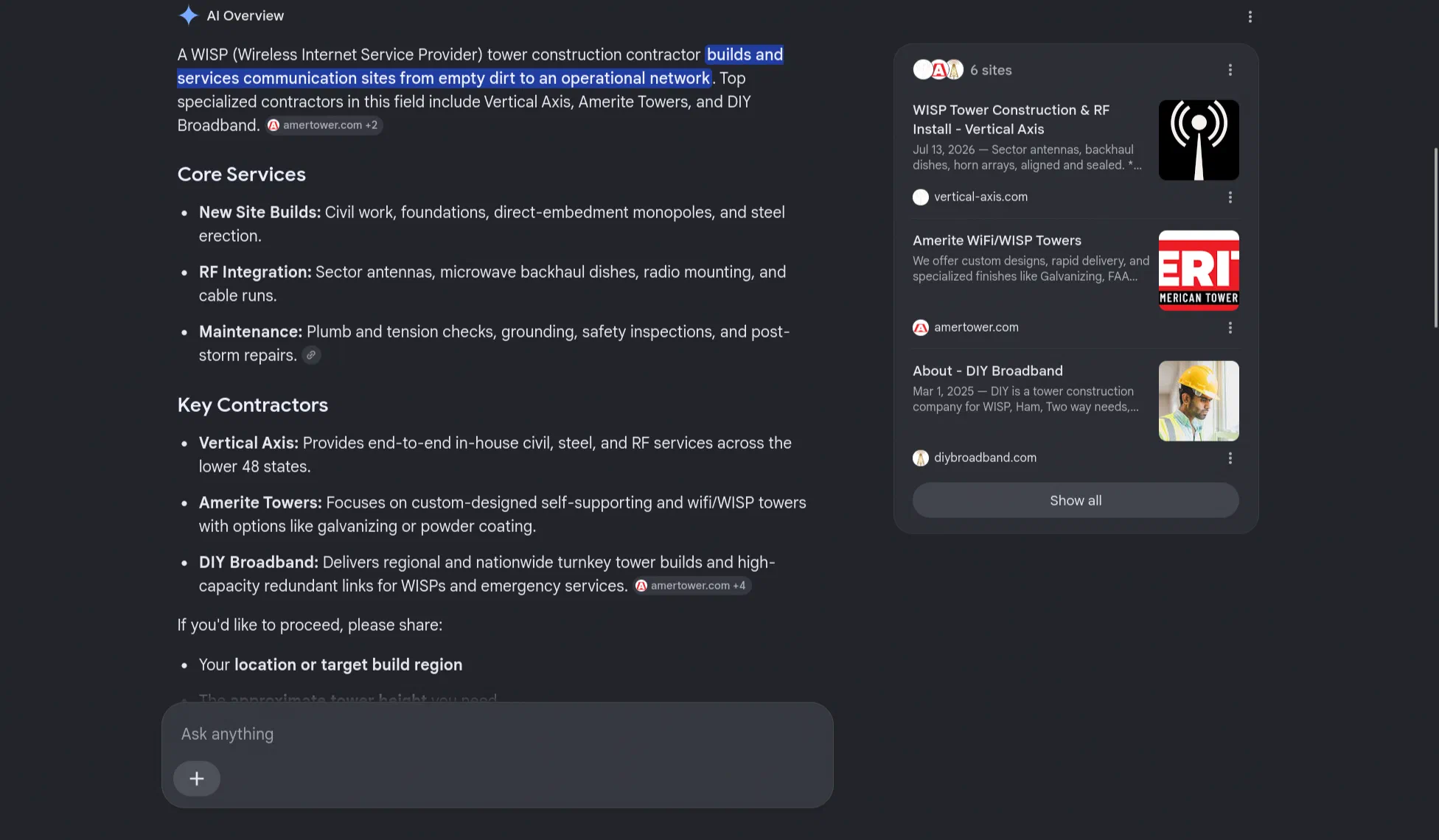
Ask Google for a WISP tower construction contractor and the AI Overview names Vertical Axis first among the specialists, with the site at the top of its sources. Look closer at the sentence before the list, though, because that is the part worth the whole engagement. Google explains what this kind of contractor even is by saying one “builds and services communication sites from empty dirt to an operational network.” The services page says: empty dirt to operational tower, one crew, one point of contact. The engine did not merely cite the page. It borrowed the page’s sentence to define the category.
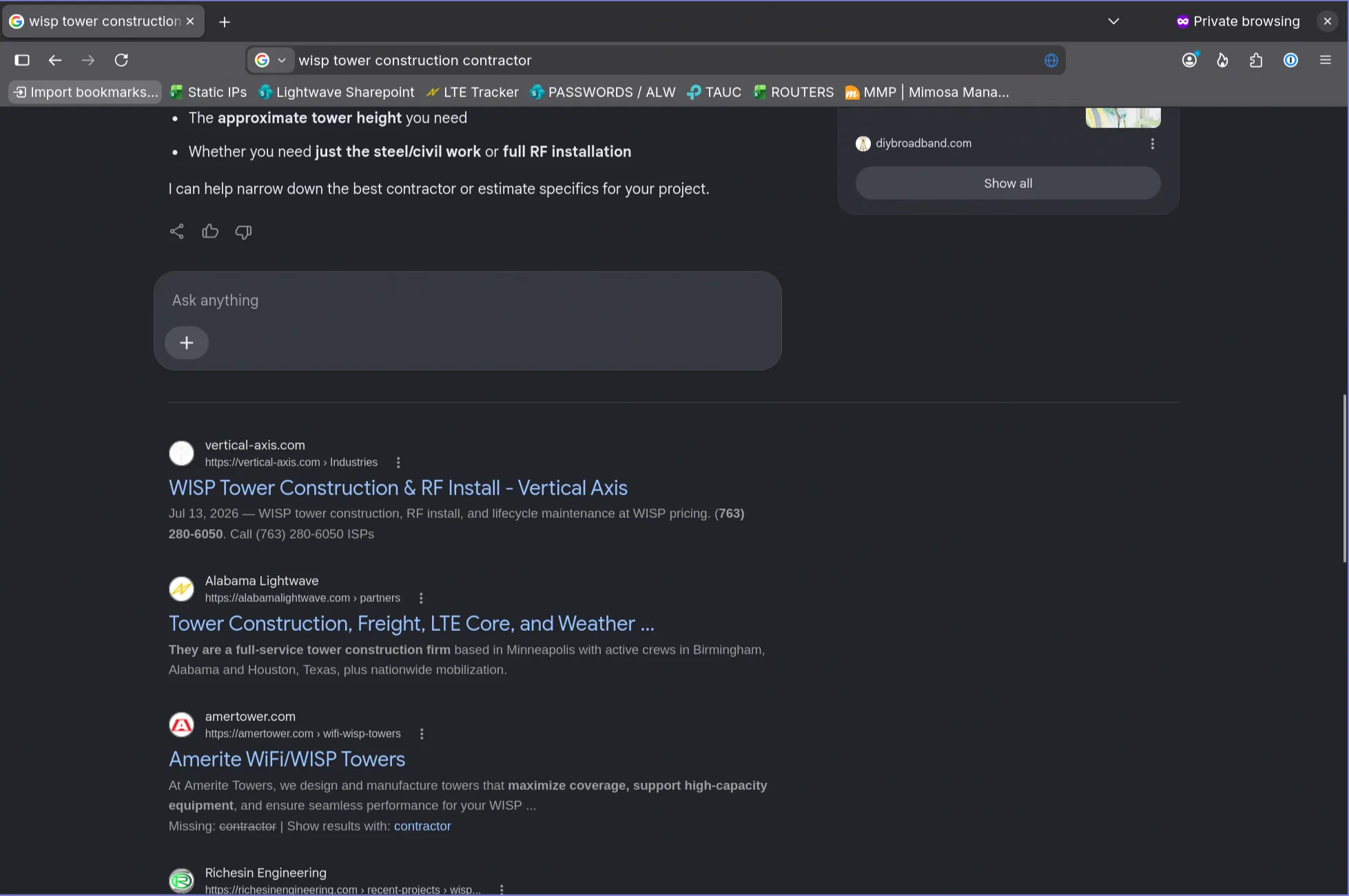
Underneath the summary, the WISP industry page is the first organic result for the same query.
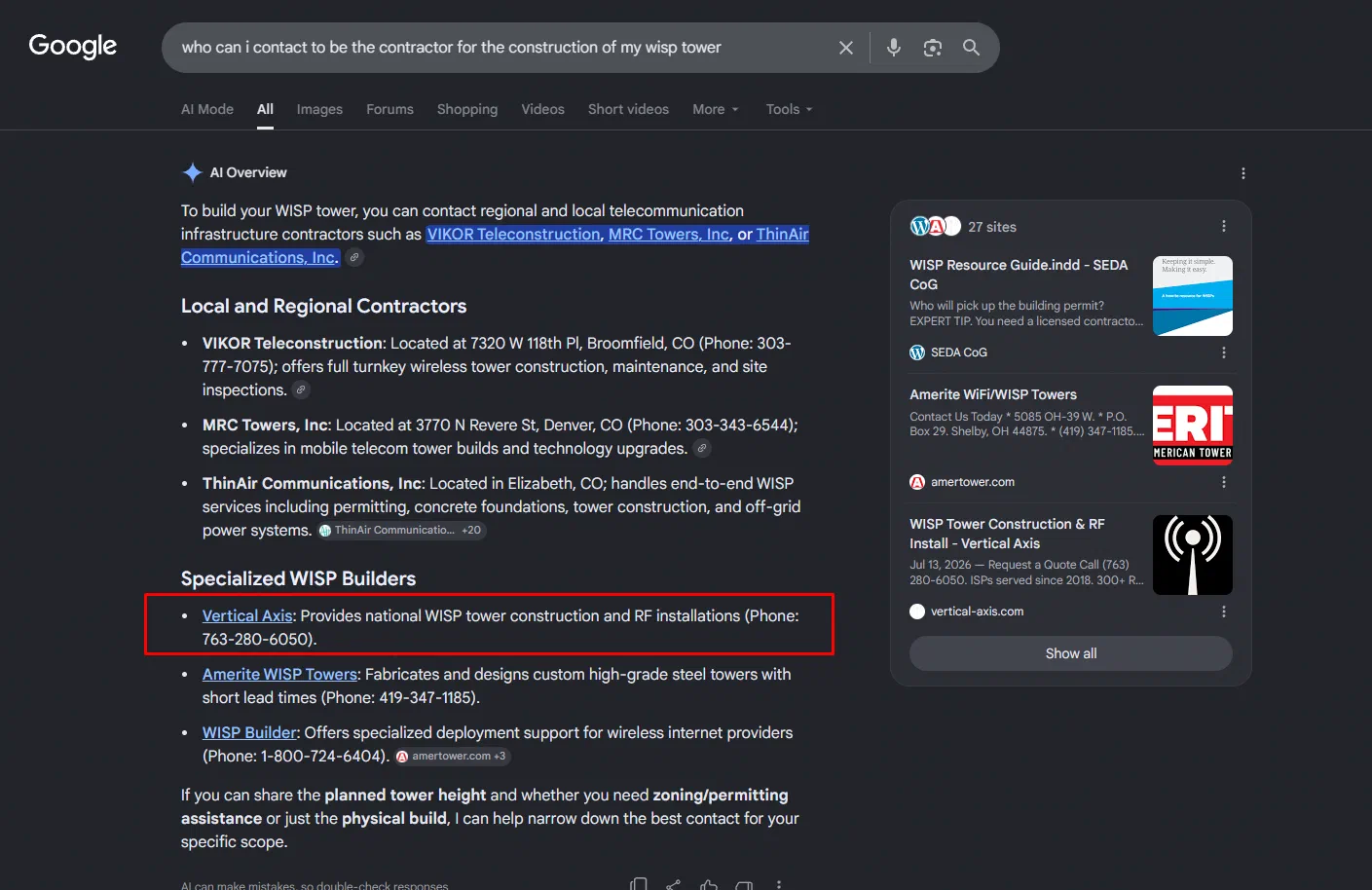
It holds up when the question is asked the way a person actually talks. “Who can i contact to be the contractor for the construction of my wisp tower” returns Vertical Axis under specialized builders, phone number attached. That is the county emergency manager from the top of this piece, and he now has a number to call.
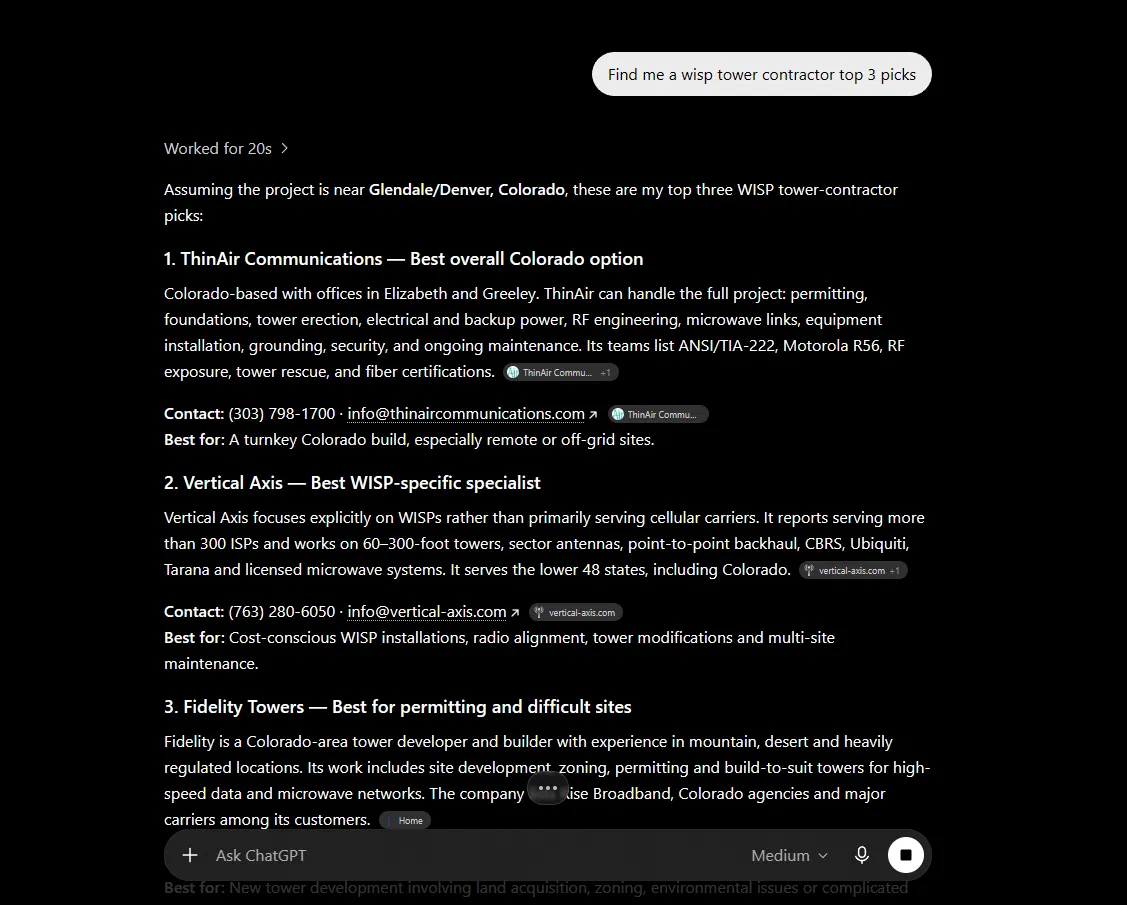
The assistants agree. ChatGPT puts Vertical Axis in its top three as the WISP-specific specialist, and note the careful phrasing: it “reports serving more than 300 ISPs.” The machine repeats the claim and attributes it, which is exactly what a specific, sourced sentence buys and what a banner slogan never earns.
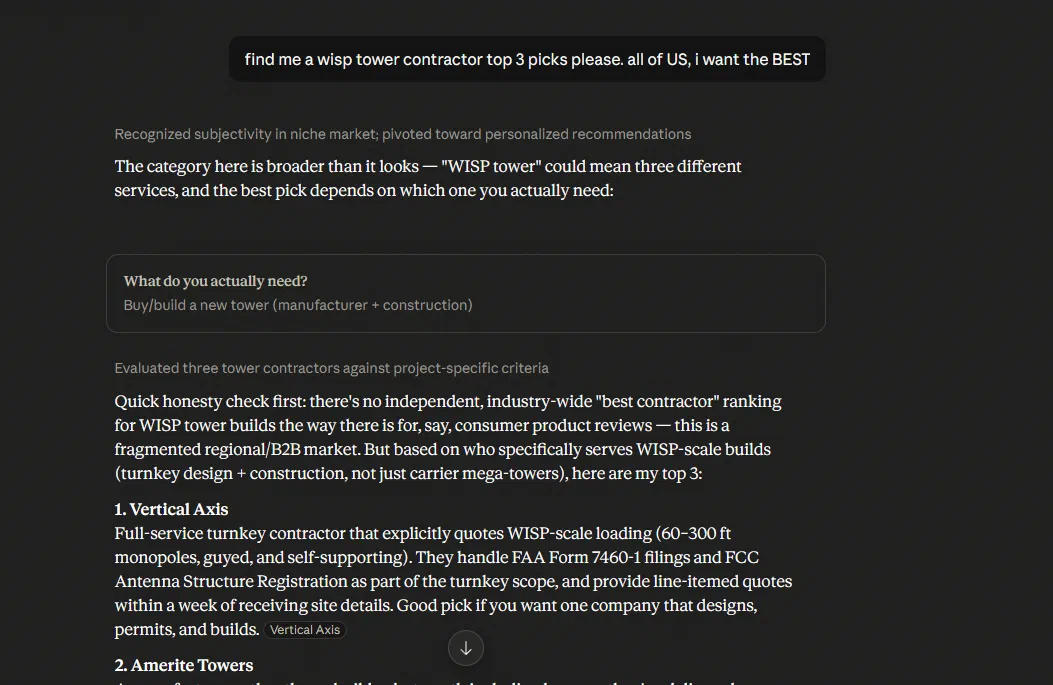
Claude ranks it first, and reaches for the details that only exist because somebody wrote the scope out longhand: the 60 to 300 foot loading range, FAA Form 7460-1 filings, FCC antenna structure registration, a line-itemed quote inside a week.
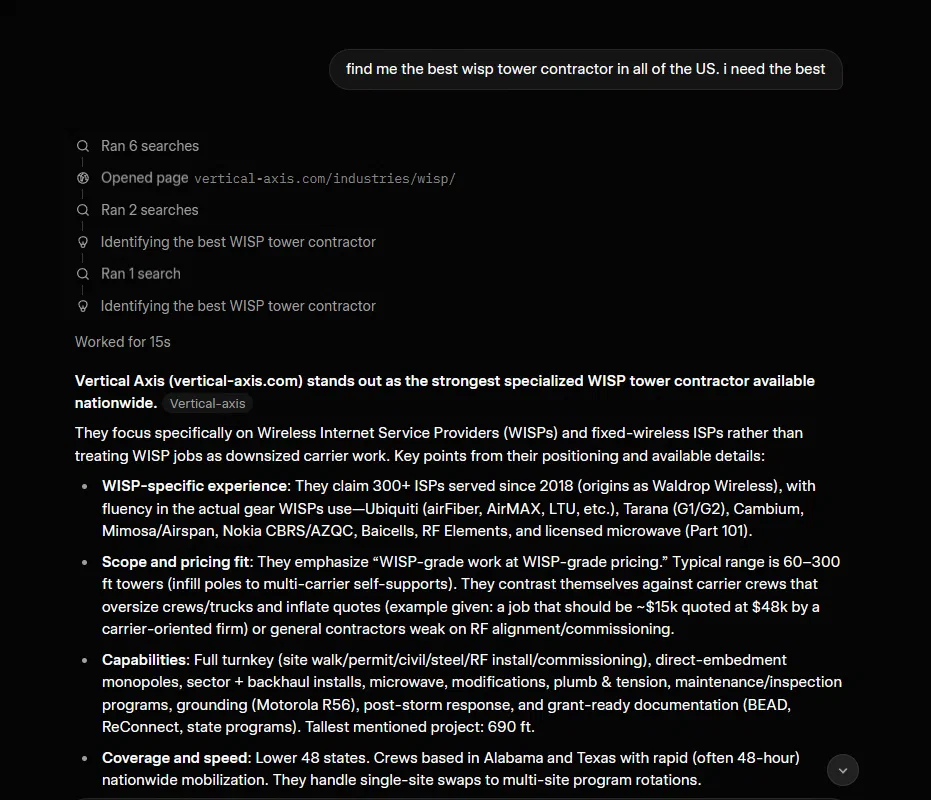
Grok is the clearest of the lot, because it shows its work. Six searches, then it opens the WISP industry page and reads it, and what comes back is that page said aloud: three hundred providers since 2018, the gear list a WISP would recognize, WISP-grade work at WISP-grade pricing, the 60 to 300 foot range, the job that should cost fifteen thousand and gets quoted at forty-eight by a carrier crew, Motorola R56, BEAD and ReConnect, 690 feet, the lower 48, crews in Alabama and Texas, mobilization inside about forty-eight hours. Not one invented detail in it.
None of that came from the markup. It came from the pages saying specific true things in the buyer’s own words, which the markup then made easy to find. And being named is still not the same as being hired: the quote form is the real scoreboard, and that number takes longer to move than a citation does.
What it is for
Vertical Axis is a company of people who drive to a pasture, auger a hole, and put steel in the sky, and none of them will ever have time to think about retrieval. What they needed was for eight years of finished work to exist somewhere a stranger, or a stranger’s assistant, could find it and repeat it accurately. Write down what is true in the buyer’s own words, in enough detail to be quoted, with proof somebody could check and names attached, and then make it legible to the machines. Rankings follow, and so does the quote request from a county nobody in the company has ever worked in.
If you run a business that makes something real and your website is quieter about it than your customers are, that is the work I do through Centreville Tech. Have a look at what we built them, then send me an email and tell me what you make.