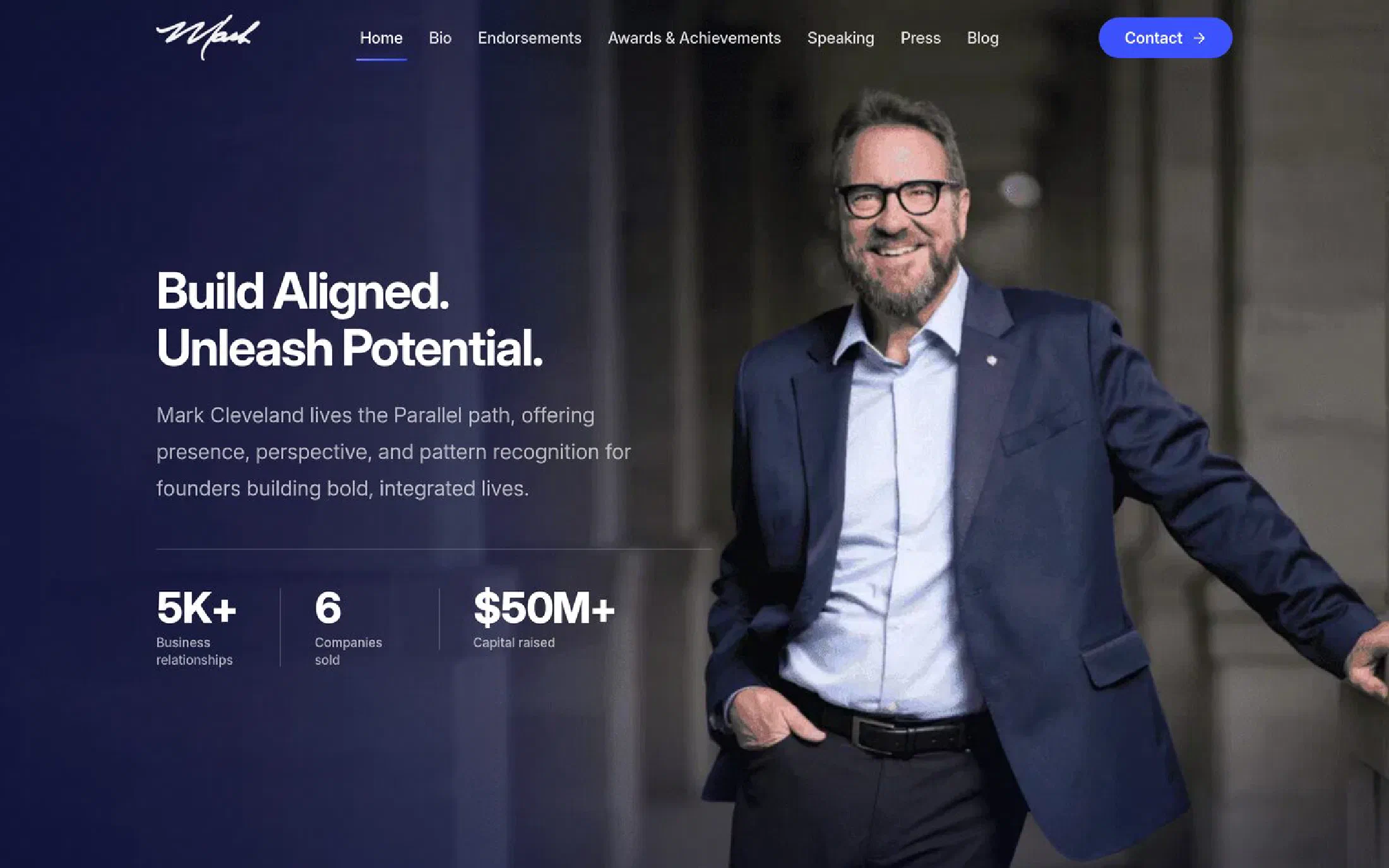
Nashville runs on introductions, and for forty years Mark Cleveland has been one of the people the introductions run through.
He helped start a barge line between Texas and Florida. He built Hobby Express and sold it. He co-founded Swiftwick and proved you could still make a first-rate athletic sock in Tennessee. Then he built Hytch Rewards and spent years trying to talk Middle Tennessee out of driving to work alone. Six companies started from scratch and sold. More than fifty million dollars raised. Something like five thousand people in his phone.
These days he advises founders who are getting ready to buy a company, sell one, or grow into the next thing. That work runs on trust, and trust runs on who knows you.
Which is exactly where the trouble starts.
Everyone inside Mark’s circle knows precisely who he is. Nobody outside it can find out.
Picture a founder in Chattanooga. He has put nineteen years into his company. His wife thinks this might be the year to sell. He does not have Mark’s number, and he does not know anyone who does. So he does what all of us do now. He types a question into Google, or he asks an assistant. Whatever comes back becomes his short list, and he calls two or three of those names.
If Mark is not in that answer, Mark never gets the call. It makes no difference how good he is.
The picture was never the problem
Mark’s old website was not ugly. That is exactly why it is worth showing you.
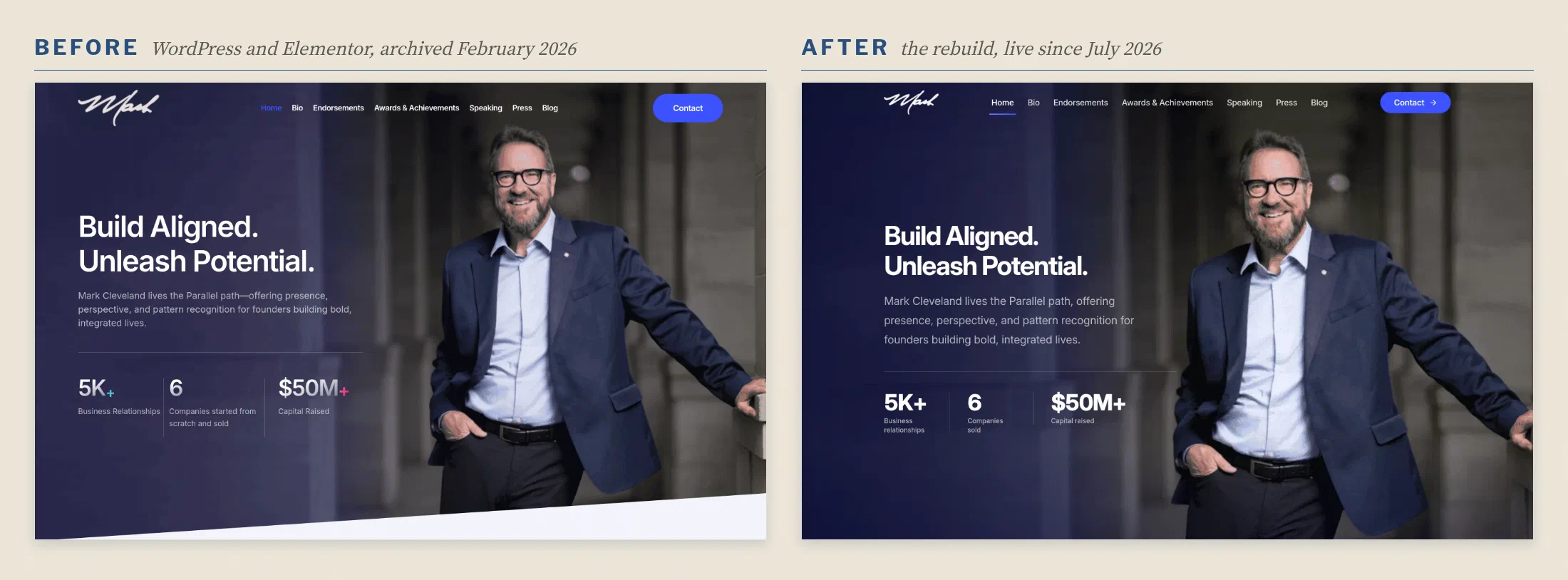
The old one is on the left, saved by the Internet Archive last February. The new one is on the right. Set side by side, you would be hard pressed to say which is better. The work that mattered here does not show up in a screenshot.
It had a good photo of Mark. It had a clean headline. Somebody with taste had clearly worked on it. And it was costing him business every week, for reasons nobody looking at it could see.
The page listed six ways to hire him. Each one was a card with a title and a little icon, and that was all you got. The sentence telling you what the service actually did was hidden on the back of the card. You had to hover your mouse over it to flip it around. On a phone, most people never found it at all.
Thirty-three photographs sat on that page and not one of them had a description attached. A person looking at the page saw Mark. Anything reading it saw thirty-three blanks.
Buried in the page was a short summary written for search engines, which is a normal thing to have. Mark’s described his life’s work in four phrases: “multiple company exits with significant value creation,” “recognized Nashville business superconnector,” and two more just like them. Nothing anybody could check. Meanwhile the man has a Governor’s award with a year on it, and that summary never mentioned it.
The footer still said 2025. More than a megabyte of code arrived before the first photograph did. And the whole thing sat on WordPress, where something always needs updating on a morning you have better things to do.
Worst of all, the page never came out and said what Mark does. Search engines and AI assistants read a page looking for exactly that. His did not say it, so they had nothing to repeat.
Say the work out loud
We started by saying, in ordinary English, what somebody is actually buying, and putting it where a reader will meet it.
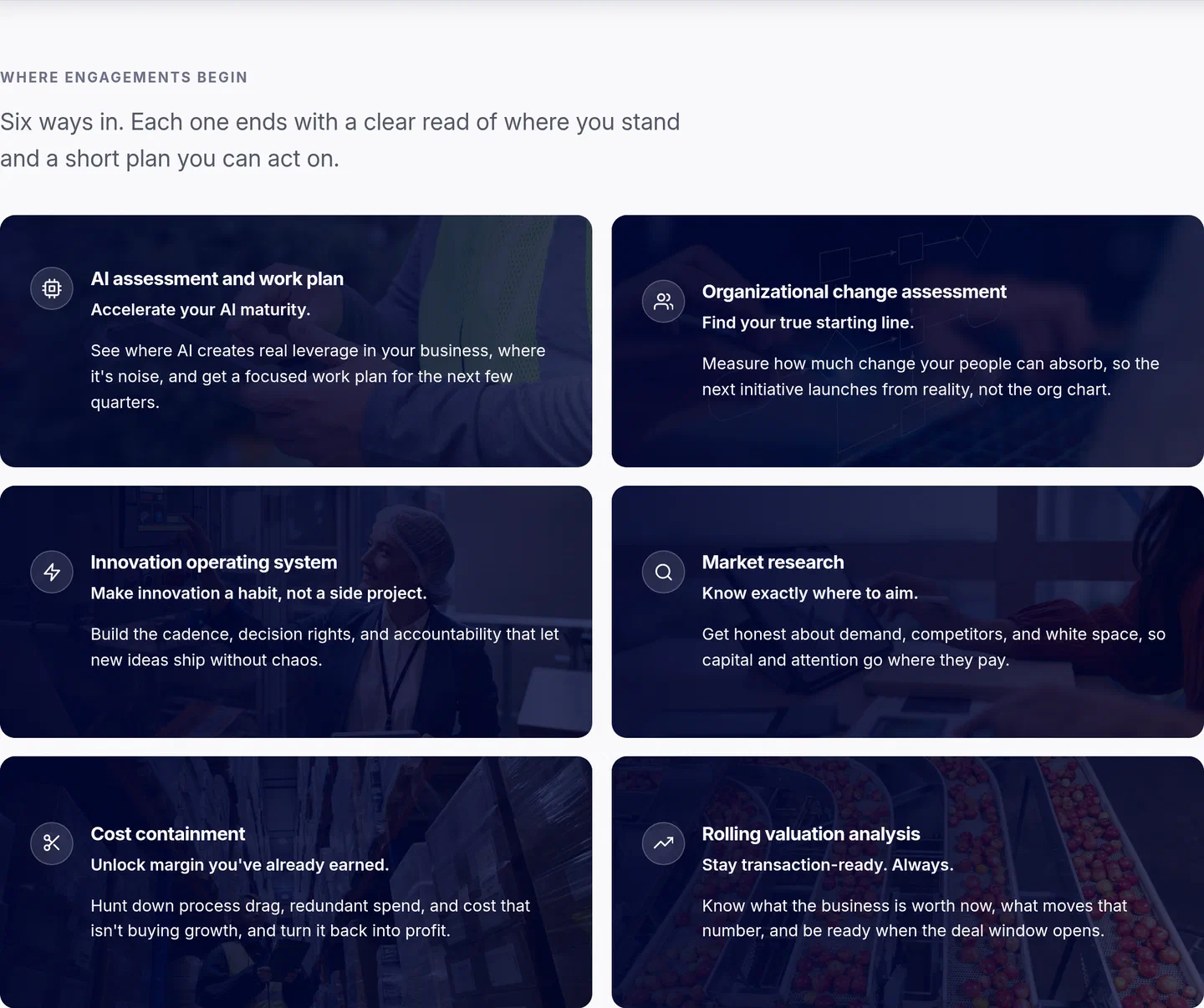
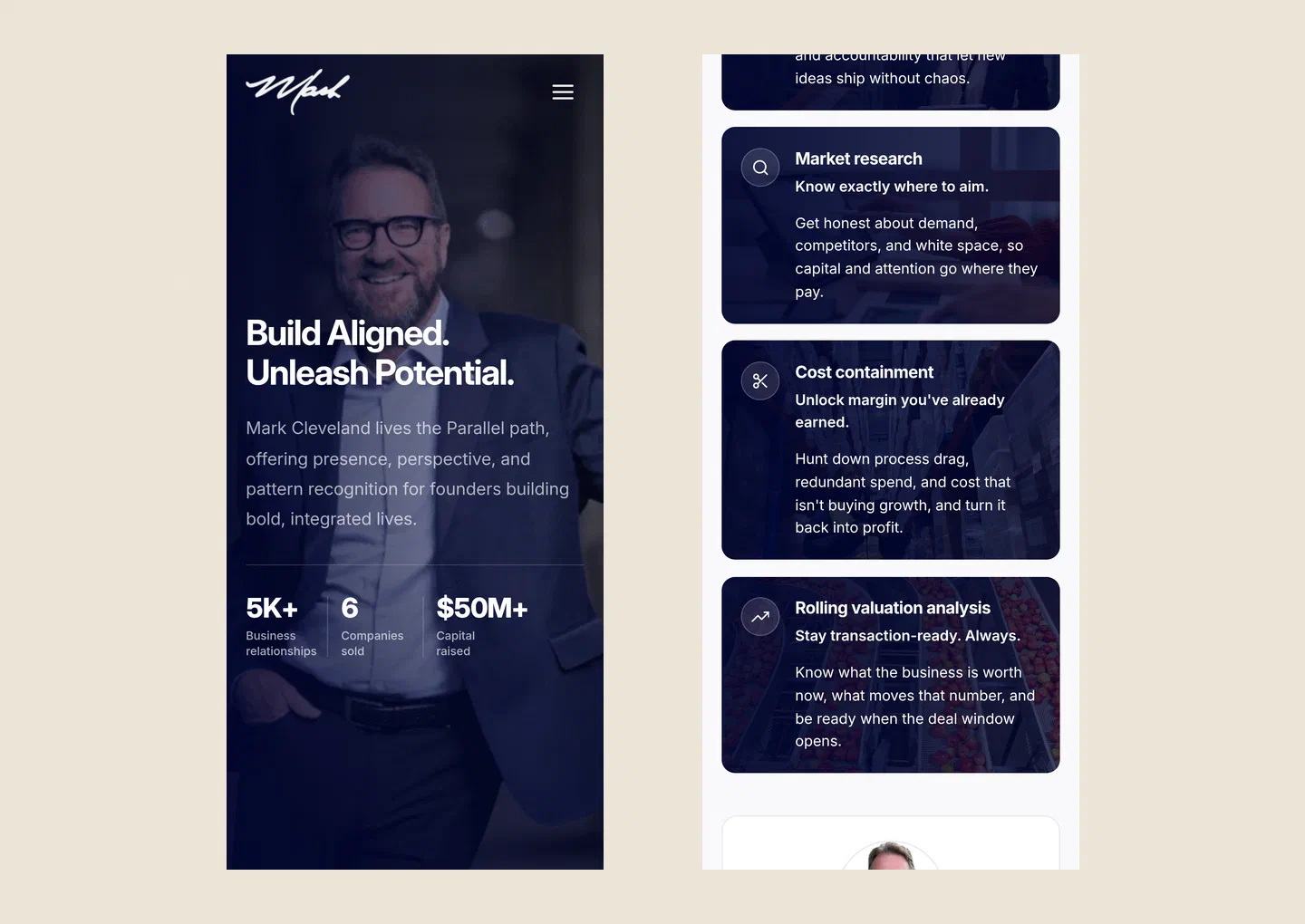
Six ways in, and now you can read all of them without touching anything. Cost containment hunts down wasted spend and turns it back into profit. Rolling valuation tells you what your company is worth today and what would move that number. Market research tells you who is really buying and who is not.
A founder reading those knows in ten seconds whether he has that problem. So does a search engine. So does an assistant summarizing the page for somebody who will never visit it.
The section ends with a conversation instead of a form.
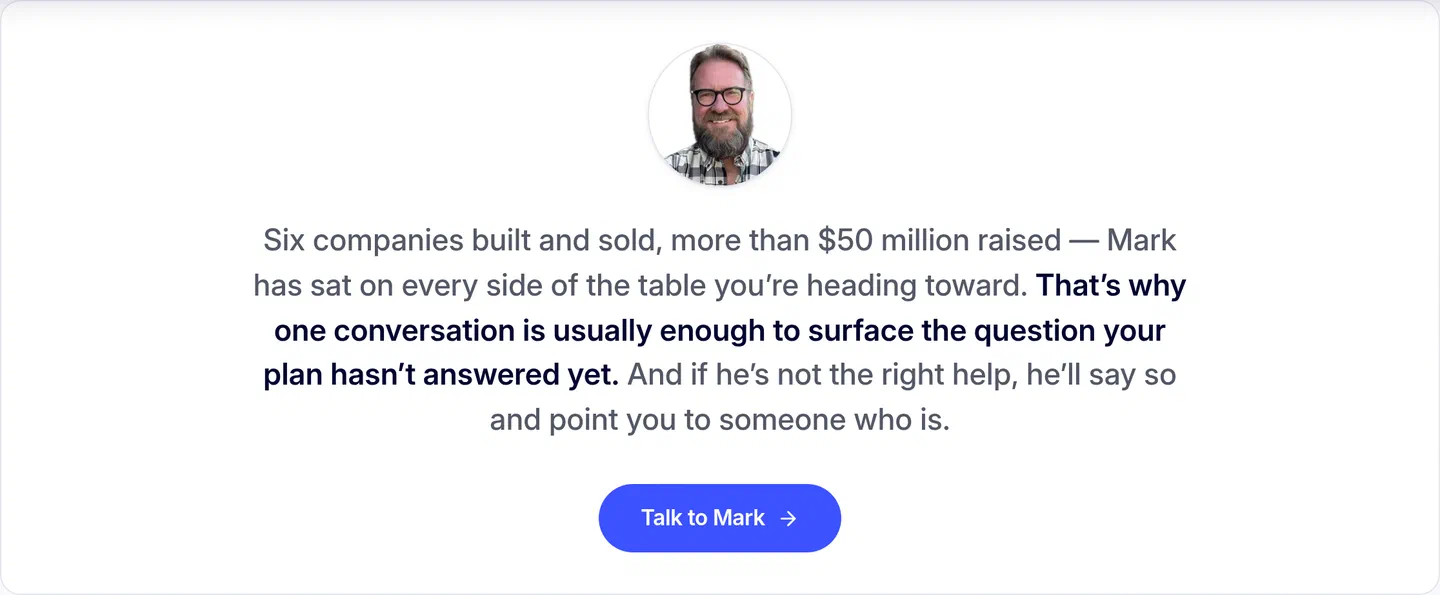
Read the last line of it: “And if he’s not the right help, he’ll say so and point you to someone who is.”
Every advisor on earth promises to be a good fit. Almost none of them will say out loud what happens when they are not. Saying it is worth more than another paragraph of credentials, because it answers the question a nervous founder is actually asking.
The proof was already there
Nearly everyone we work with has this problem, and Mark had it badly. His proof was already sitting on that website. It simply was not reaching anybody.
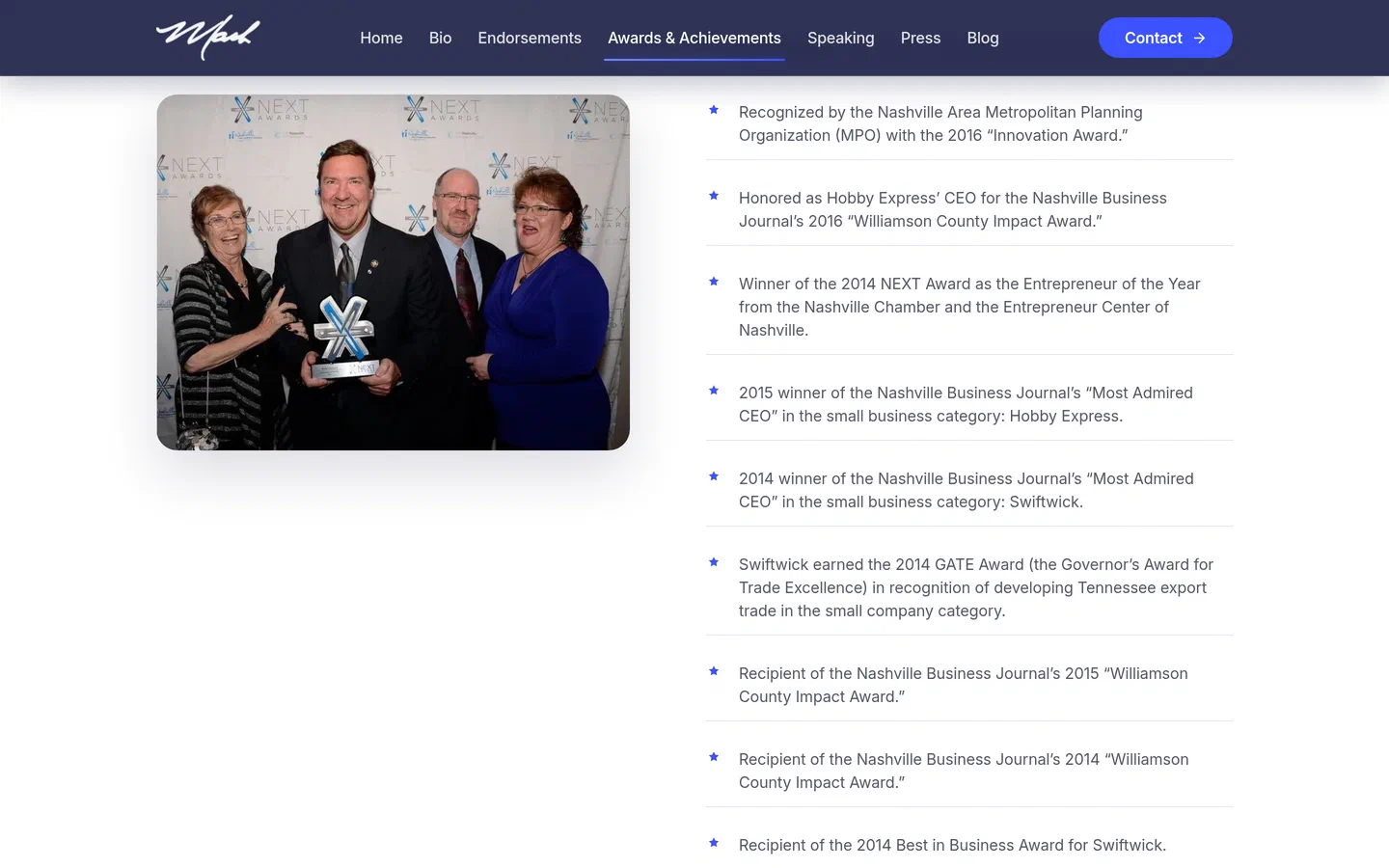
Thirty-four awards and honors, every one named and dated. In Charge for transportation and logistics, three years running. Most Admired CEO from the Nashville Business Journal, three separate times at three different companies, which is far harder than winning it once. The Governor’s award for clean air. The Governor’s award for export trade. Rotarian of the Year, twice, twenty years apart.
All of that was sitting on the old site as two long bulleted lists. We gave it a page you can actually read, put the photograph of him accepting the NEXT Award beside it, and fed those real award names and real years into the part of the page search engines read, replacing the four fuzzy phrases that had been standing in for them.
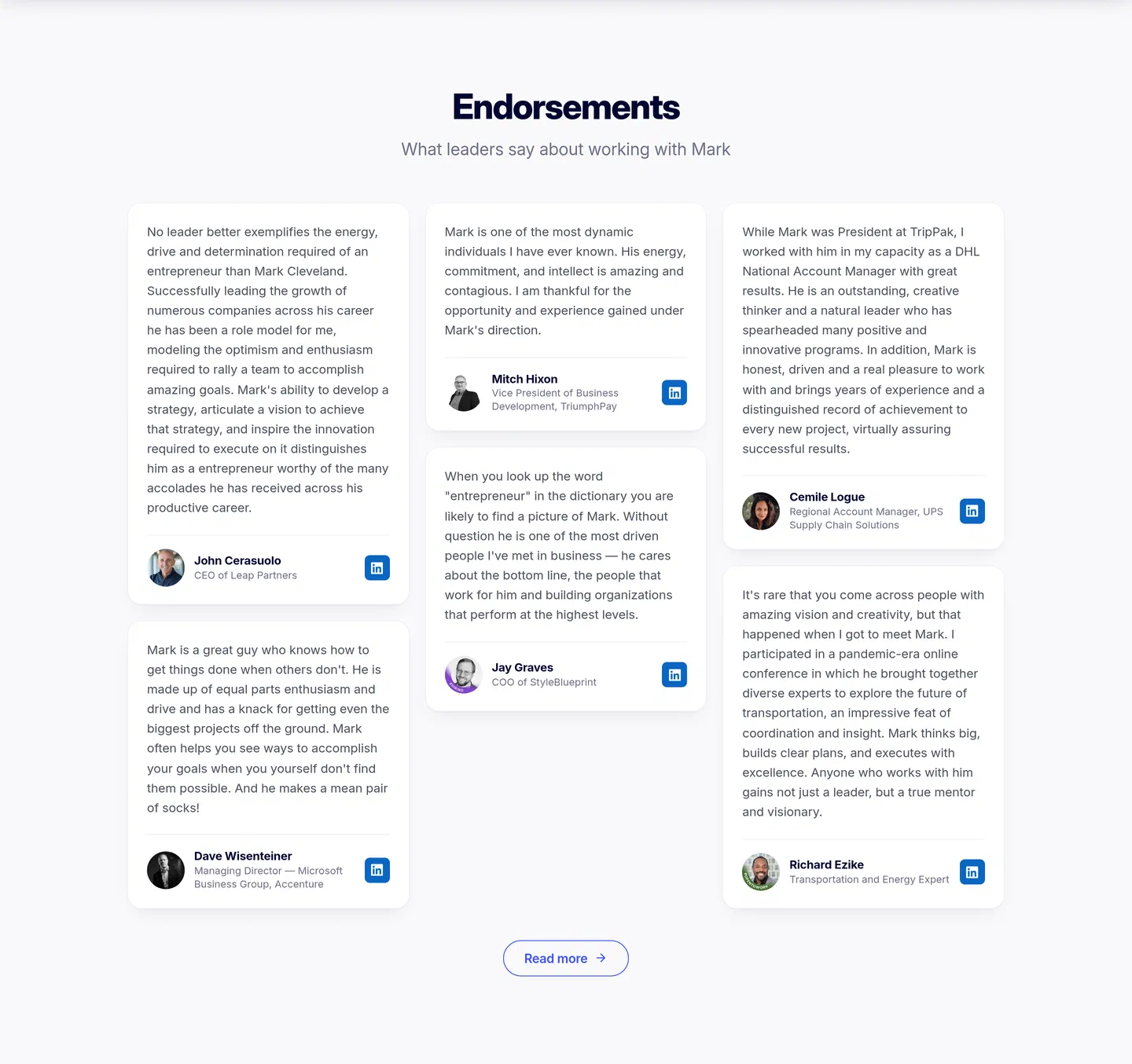
Same story with the endorsements. Nine serious people had already written glowing things about him and signed their names to them. The CEO of Leap Partners. The COO of StyleBlueprint. A managing director at Accenture. The CEO of Becker Logistics. One of them, David Gerber, writes: “He does exactly what he says he’ll do, even when it’s hard, and that matters more than any skill set.”
All of it was buried at the bottom of a long page most visitors never scrolled to. Now it has its own page, and the strongest three ride along on the home page where a first-time visitor meets them. Every card keeps the face, the job title, and the link to that person’s real profile, so a stranger can leave the page and confirm it.
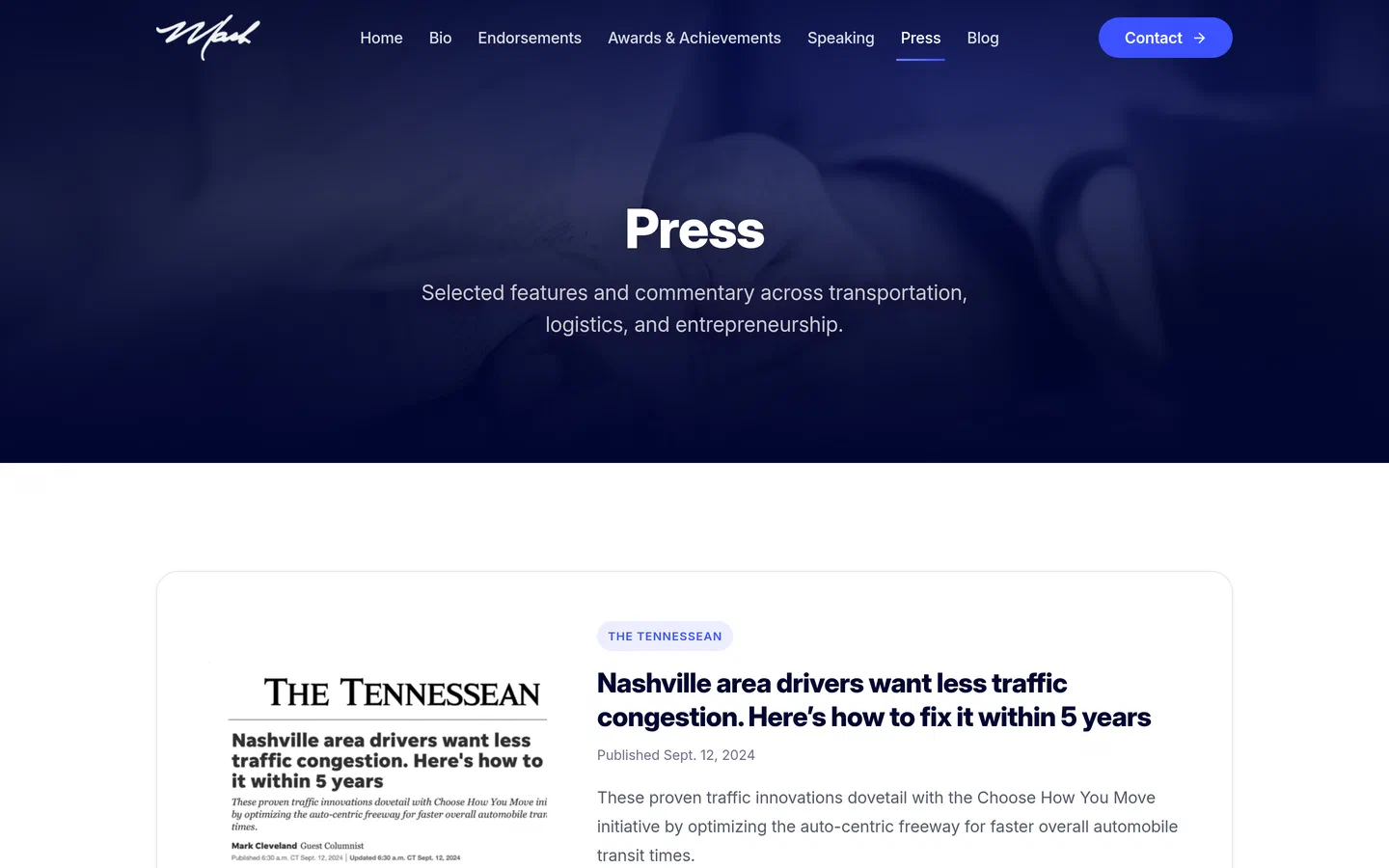
Press works the same way. Real outlets, real dates, links that send you off the site to the article itself. None of it is Mark’s opinion of Mark, which is the entire value of it.
Then let people meet the man
Credentials get you onto the short list. What gets you the call is somebody deciding they would like to sit across a table from you, and that is written in a completely different voice.
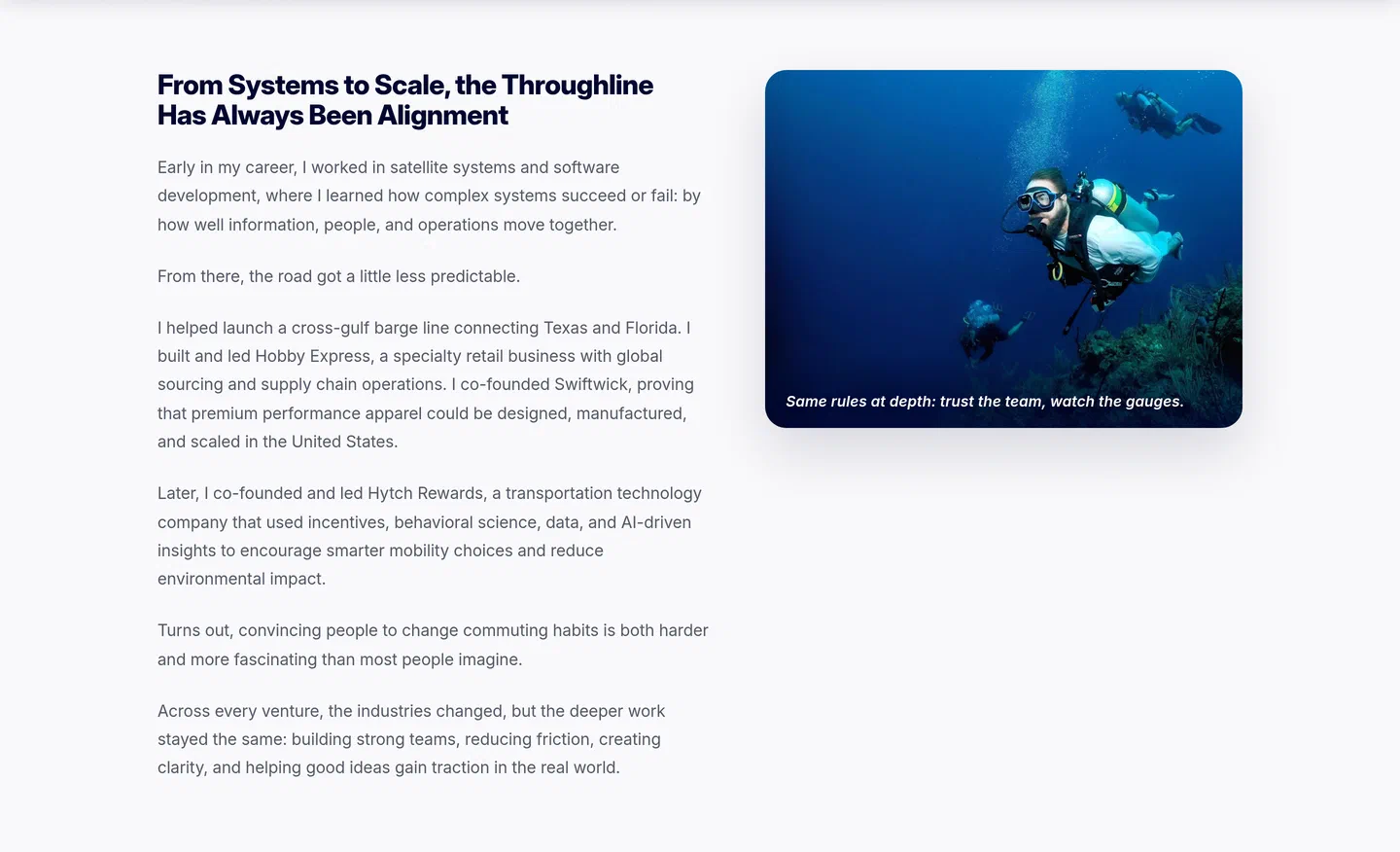
So the bio became a story told in chapters, each with a real photograph and a caption. Mark diving. Mark at his podcast desk. Mark at the office. Mark speaking to a Rotary room. None of it is stock photography. Read the captions, too: “Every deal is a handshake with somebody’s life’s work.”
The line the whole page turns on is his own. “I’ve never been particularly interested in building an empire. I’m much more interested in building ecosystems.”
He also hosts The Parallel Entrepreneur, where he interviews founders who are running more than one venture at a time, so the three latest episodes now sit on the home page as well. It is the same argument in audio: here is a real person, at length, thinking out loud.
Not one word of that ranks for a search term. All of it is why somebody picks up the phone.
Built to be found, and to stay found
The rest is plumbing. Dull to describe, and it decides whether anything above ever gets seen.
Every page now tells search engines and AI assistants, in a format made for them, who Mark is, what he has won, and what he offers. We did the same thing for a tower contractor in Alabama last spring, and you can read how that turned out, because Google, ChatGPT, Claude, and Grok all name that company at or near the top now. There is a plain summary of his whole career sitting at an address the AI crawlers look for, so an assistant answering a question about Nashville dealmakers has something accurate to quote. The site also tells those crawlers plainly that they are welcome, instead of leaving them to guess.
Every web address survived the move exactly as it was, so no link anybody has ever shared or printed went dead. Small thing to get right. Skipping it is the most common way a redesign wipes out years of accumulated search rankings overnight.
The site loads in about a tenth of a second, and there is no longer a piece of software sitting under it that needs patching on a morning Mark has a deal to close. And because half the world reads standing up, the phone got the same attention as the desk. Those six service cards, hidden behind a hover in the old version, sit wide open on a phone.
Where it stands
The site went live on the eleventh of July, and three weeks is nothing. Rankings move slowly and citations inside AI assistants move slower still. So take what follows as a progress report.
What can be said already: search a phrase like Nashville dealmaker and parallel entrepreneur, and both his home page and his bio come back, and the summary attached to them is built out of the new bio’s own sentences. Words written in July are already being read back to strangers.
Being quoted is not the same as being hired. The real scoreboard is the contact form, and that one moves on a slower clock.
If any of this sounds like you
You have probably built something real. Maybe you have run companies, or sold one, or spent thirty years becoming the person everybody in your industry calls. The people who already know you have no doubts about you at all.
The problem is everybody else.
The buyer who has never met you, the board looking for a new director, the founder trying to decide who to trust with the biggest decision of his life: all of them start the same way now, by asking a machine. What that machine says about you is decided by what your website is willing to state plainly, and by whether a stranger can check it.
Most good people have a website that is prettier than it is useful. It has a nice photo and says almost nothing. Meanwhile the proof of an entire career sits in a drawer, on a LinkedIn profile nobody reads twice, or in the heads of people who are too busy to introduce you. People remember what they can see, which is an argument I have made about towers and which turns out to be just as true of a career.
Getting that written down is the work. At Centreville Tech we build personal brands and websites for people who have earned one: the story told properly, the proof laid out where a stranger can check it, the photographs that make you look like a person instead of a headshot, and the technical work underneath that puts all of it in front of the search engines and the assistants people ask now.
Have a look at what we built Mark, including the page where a stranger can now simply call him. Then send me an email and tell me what you have built. If I am not the right help, I will say so and point you to someone who is.