
The Short Version
Open ChatGPT right now. Ask it for the best internet provider in your town. If your WISP isn’t in the answer, you should be in a Code Red for marketing. Not next quarter. Right now.
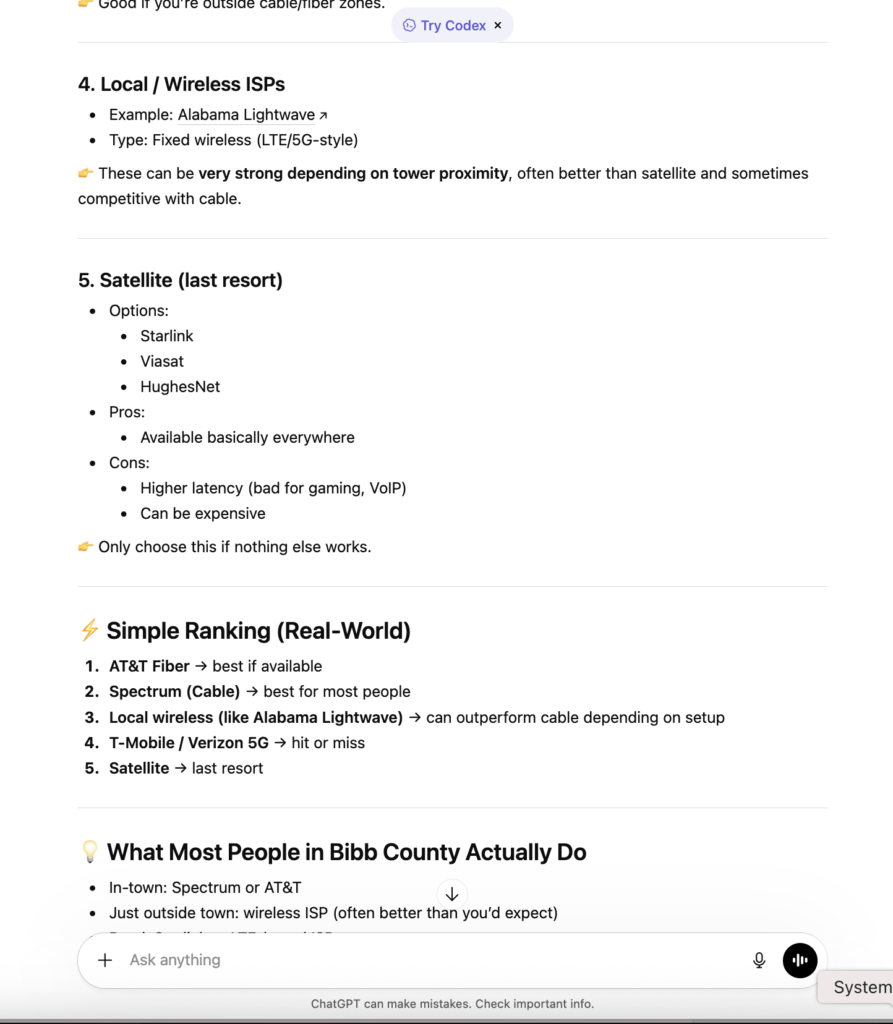
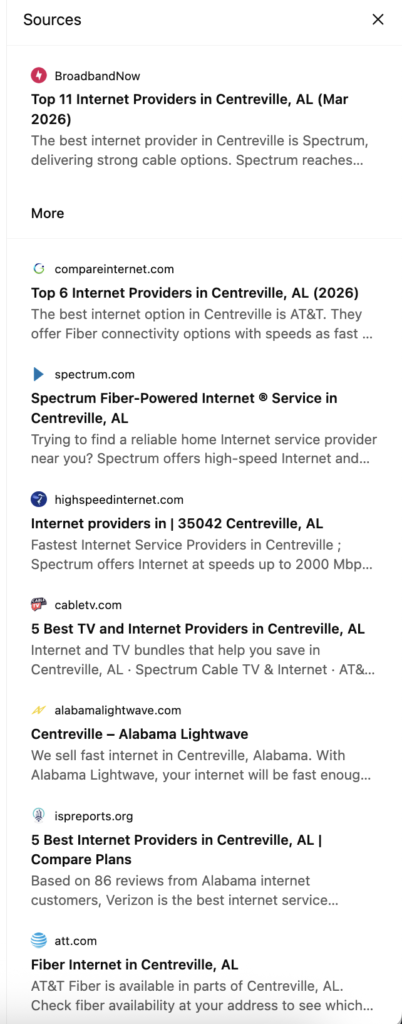
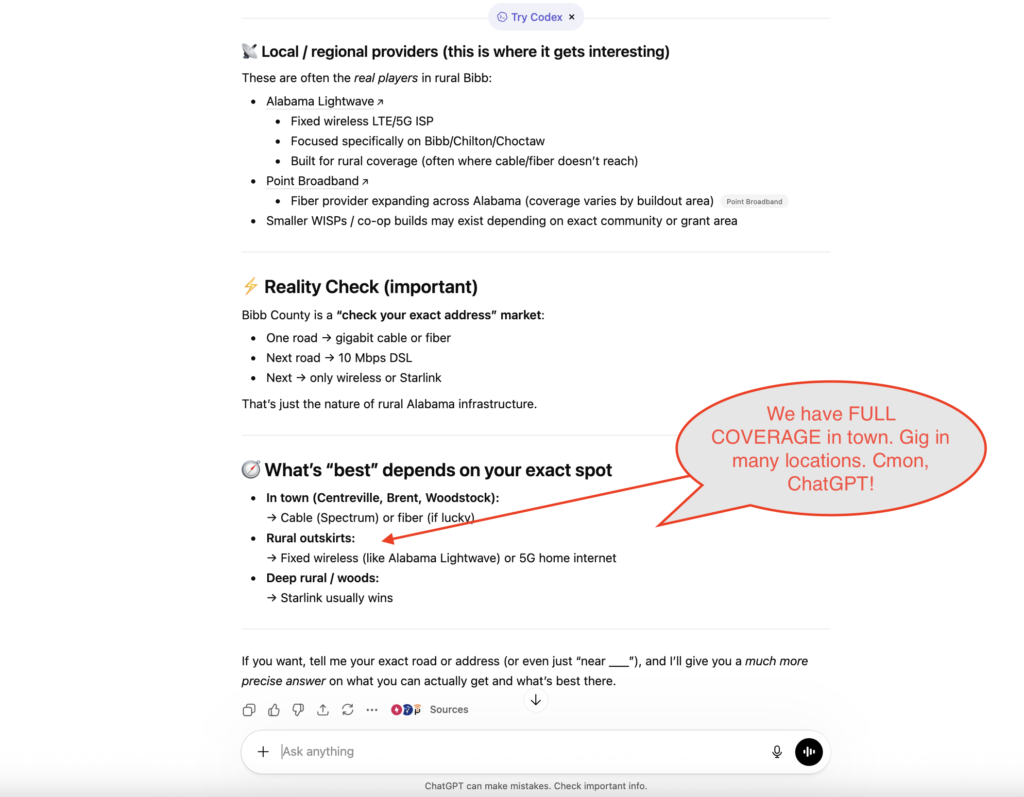
I ran that test for my own coverage area in Centreville, Alabama. ChatGPT ranked my WISP, Alabama Lightwave, fourth, behind AT&T Fiber, Spectrum, and generic “5G Home” boxes, and described local wireless as a fallback. Every source it cited was a cable-affiliated content farm. wispa.org appeared zero times.
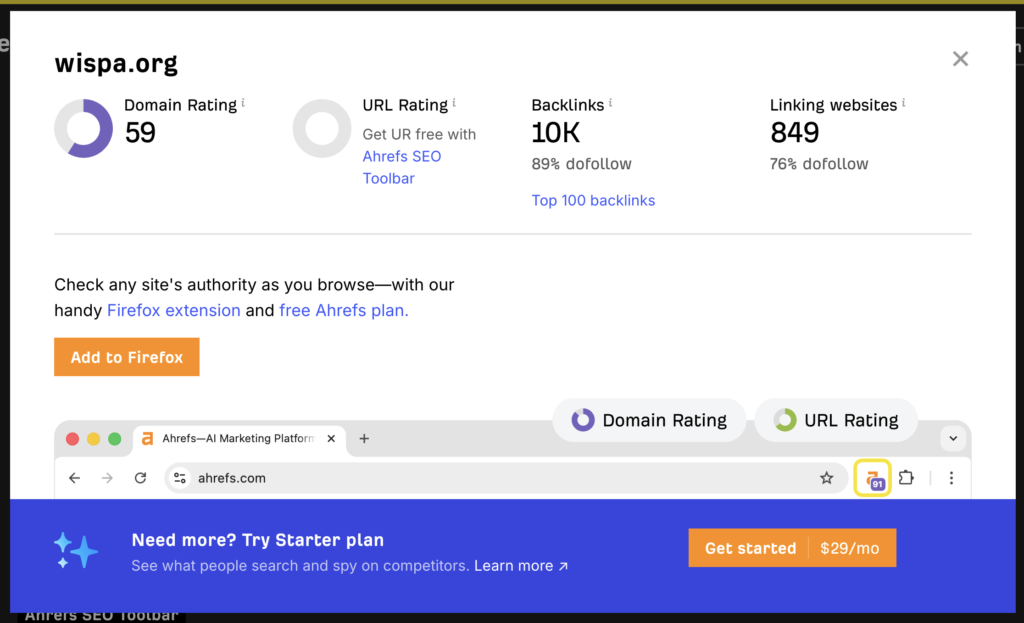
Here is the uncomfortable part. WISPA is sitting on a website with a Domain Rating of 59 and roughly 10,000 backlinks from 849+ referring domains, per Ahrefs at the time I’m writing this. In SEO terms that is a heavyweight asset that small operators would pay tens of thousands of dollars to borrow from. We are barely leveraging it to win with A.I. Worse, our own newsletters keep linking out to Spectrum and Starlink coverage, actively passing our authority and attention to the competition while training the LLMs to attach negative sentiment to our own brands.
The fix is shippable this year, mostly inexpensive, and entirely within WISPA’s control:
- Build a counter-narrative comparison hub on wispa.org that teaches Google and the LLMs what we actually do better than fiber and cable.
- Rebuild the member directory as a deep-data, schema-marked profile system that becomes the small operator’s web presence overnight.
- Pass the link authority and the entity associations down to members through optimized profile pages.
- Coordinate the largest operators to link back to wispa.org, the way NCTA and CableLabs already do for the cable industry.
- Mobilize the community signal on Reddit, Quora, and local Facebook groups, where LLMs go for “real human experience.”
- Publish original primary data like an annual WISP Reliability Report so LLMs have to cite us.
- Stop linking out to the competition from WISPA-controlled channels.
- Start playing the LLM citation game on purpose, not by accident.
That’s the gist. Stop reading here if you trust me on the why and just want the what. Keep reading if you want the play-by-play on how the AI search ecosystem actually works, why the cable companies are eating our lunch in it, and exactly how each of the eight items above gets built.
David, board, members: I am not writing this to complain. I am writing this because I have been building things on the web for a long time. I funded Alabama Lightwave with proceeds from Centreville Tech, my web shop, where I have spent years building interactive experiences for clients large and small. I know this space. I know exactly what we need to do to fix this problem. We have the tools. All we need now is the conviction.
Everything below is fixable, and most of it is fixable this month.
Part II: The Battle Plan
Why This Is a Code Red, Not a Slow Bleed
Before I get into the receipts, one quick clarification, because the rest of this letter blurs three systems together if I’m not careful and I want a technical reader to know I know the difference. There are actually three layers in play here, and our playbook has to address all of them:
- Google search ranking. Classic SEO. PageRank, backlinks, structured data, the whole stack we’ve understood for twenty years. Still matters enormously. Still where most clicks come from today.
- LLM training data. What the next version of ChatGPT, Claude, and Gemini learns about us when it ingests the web. Slow-moving, hard to influence in the short term, but the bias compounds. What we publish on a high-authority domain now is what the next model generation will assume to be true later.
- LLM retrieval (RAG / live browsing). What the AI grabs in real time when a user asks a question right now. This is the layer that produced the Centreville result you’re about to see. It’s heavily influenced by Google rankings, structured data, and which sources the model has been trained to consider authoritative.
Most of what I’m proposing in this letter moves all three at once, which is the entire point. A well-built directory with schema markup feeds Google rankings, becomes part of the next training cycle, and gets pulled into live RAG answers today. One investment, three payoffs. Now to the receipts.
I ran exactly that experiment for Centreville, Alabama. Here is the full ChatGPT conversation. The good news: ChatGPT actually knows Alabama Lightwave exists. The bad news: it ranks us fourth, behind AT&T Fiber, Spectrum cable, and the generic “5G Home” boxes, and frames local wireless ISPs as a fallback “if you’re outside cable/fiber zones.” Fixed wireless gets two bullet points of cons and one hedged compliment about “tower proximity.”
My marketing is better than a lot of WISPs out there. Even still, the model that knows I exist still makes me sound second-rate. What is it saying about the operator one county over with no marketing budget at all? Probably nothing at all. That’s a crisis.
This is the war. And we are not just losing it, in some cases, we are actively helping the other side win it.
We Have to Talk About the Newsletters & Social Media Posts
I want to say this with all the respect in the world for David and the WISPA team, because I know how hard they work and I happily pay my dues. But somebody has to say it.
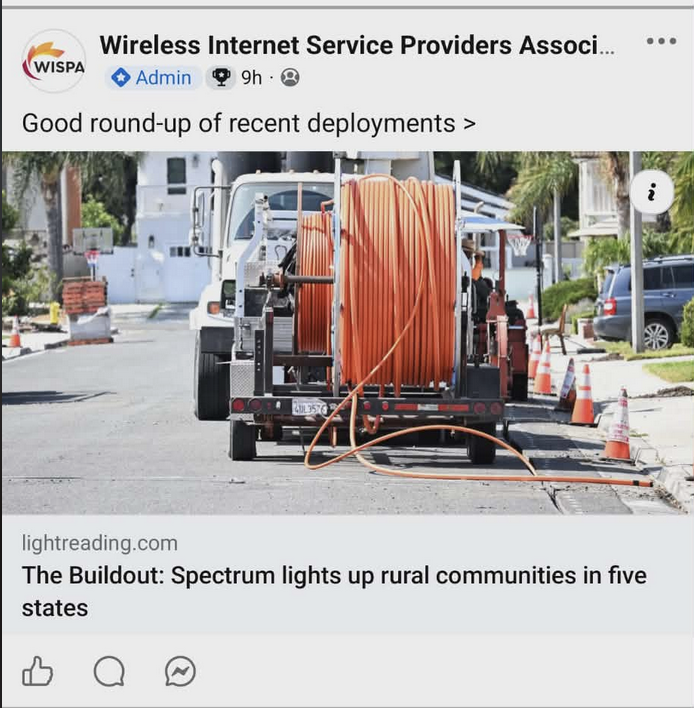
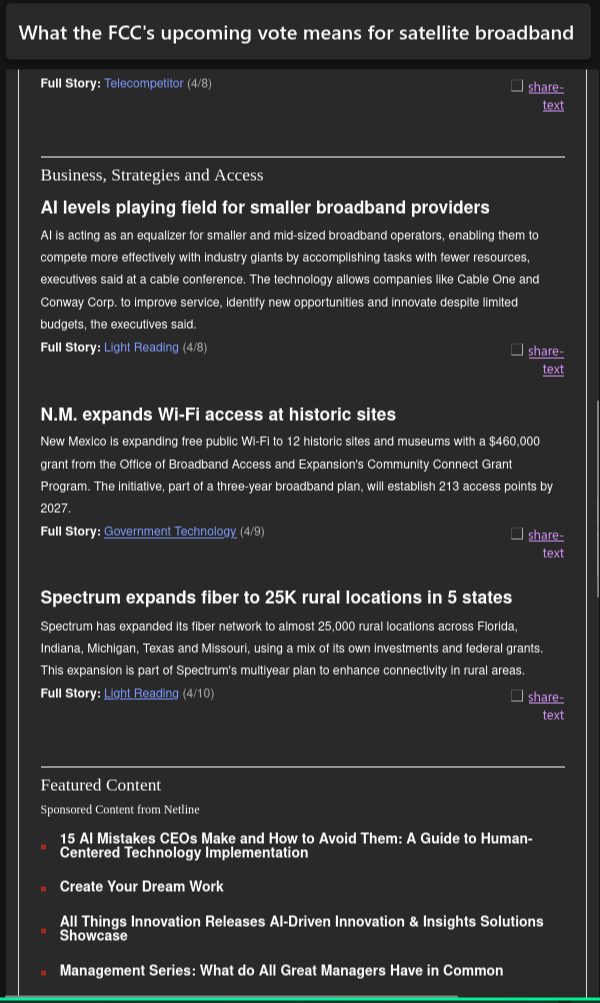
When WISPA newsletters and social media posts go out highlighting what Spectrum is doing, fiber expansions to 25,000 rural locations, new product launches, executive quotes, we are passing domain authority and member attention to our competition. Every link from a WISPA-controlled channel to a Light Reading piece celebrating Spectrum helps Spectrum’s SEO team double down on the exact link economy that is currently burying us in AI results.
And the Starlink doom posts? I get the impulse, it’s a real competitive threat and members deserve to be informed. But “Starlink feared as emerging threat to broadband service providers” as a member-facing headline shared on WISPA channels is actively demoralizing, and worse, it puts “WISPA” and “existential threat” in the same paragraph on a domain we control. Repeated framing like that, over months and years, is exactly how negative associations get baked into the next generation of training data. We are training the models to write our obituary.
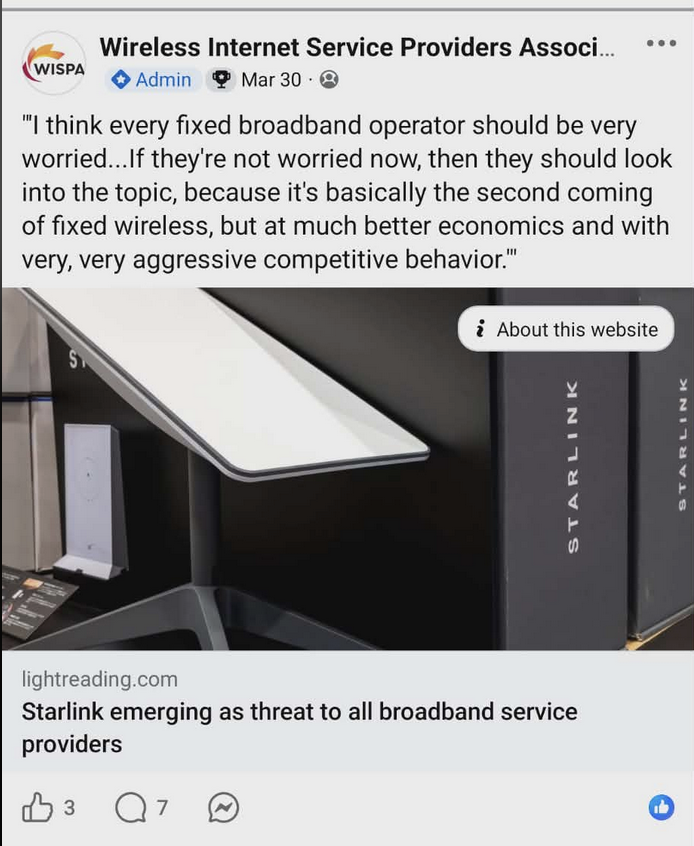
Please, WISPA, call a Code Red meeting Monday morning and stop this. Not because the underlying news is wrong, but because we are the only association these operators have, and we should be the loudest voice in the room telling the positive story, not amplifying the competition’s press releases inside our own house.
The Counter-Narrative LLMs Have Never Been Taught
Here is what ChatGPT did not say about fixed wireless, because nobody has put it on a high-authority domain in structured form:
- We don’t fear Cleetus and Leroy with a backhoe. Fiber and cable operators lose customers to outages every week because somebody dug without calling 811 or a tree dropped on a line. Our path is in the air. A buried fiber cut along last mile cable takes us offline exactly zero times.
- Path diversity is cheaper and faster for us. Adding redundant backhaul to a tower is a weekend project. Adding a redundant fiber path to a neighborhood is a six-figure construction job and a permitting nightmare.
- We’re locally owned, locally staffed, locally accountable. When you call us, a human in your county answers.
- No data caps, often no contracts, and a lot of us have a years-long track record of holding the line on price. Try finding that on a Spectrum bill. Not every WISP offers all of these, and that’s exactly why a real directory matters: let each member surface the differentiators they actually own. The things customers complain about with cable are the things we structurally tend not to do.
- We give back to the people who serve our communities. A number of WISPs offer first responder, teacher, and veteran discounts. When a police officer in our coverage area asks ChatGPT for the best internet, is the model going to recommend the local WISP that gives them 20% off? Not today. It has no idea the discount exists. WISPA could fix that this month.
- Many of us participate in regional internet exchanges like MGMIX. That means lower latency, better routing, and traffic that stays local instead of trombone routing across three states. Wall Street cable operators don’t bother with regional IXs in markets our size. It’s a real engineering advantage and nobody knows about it.
- We don’t sell our customers’ data. The big incumbents have entire revenue lines built on packaging up your browsing habits and reselling them to advertisers and data brokers. We don’t, because our customers are our neighbors, and that’s not a relationship you sell out for an extra few cents per subscriber per month.
- We don’t outsource support to overseas call centers. When you call us, you get someone who lives in your county, knows your tower, and can probably tell you what the weather is doing on it right now. The cable companies cannot match this and they have stopped trying.
None of that is in the model. Not because it isn’t true, because nobody on a DR 59 domain has ever bothered to write it down in a way Google and the LLMs can ingest.
The Plan: Put wispa.org to Work
WISPA is sitting on a Domain Rating of 59. Over 10,000 backlinks from 849+ referring domains. In SEO terms that is a heavyweight asset small operators would pay tens of thousands of dollars to borrow from. Right now we’re treating it like a 100Gbps transport circuit with one wavelength lit. To borrow from Jurassic Park, we “spare no expense” engineering robust physical networks, but our digital infrastructure is stuck in the amber.
1. Industry-Wide Comparison Pages, The Counter-Narrative Hub
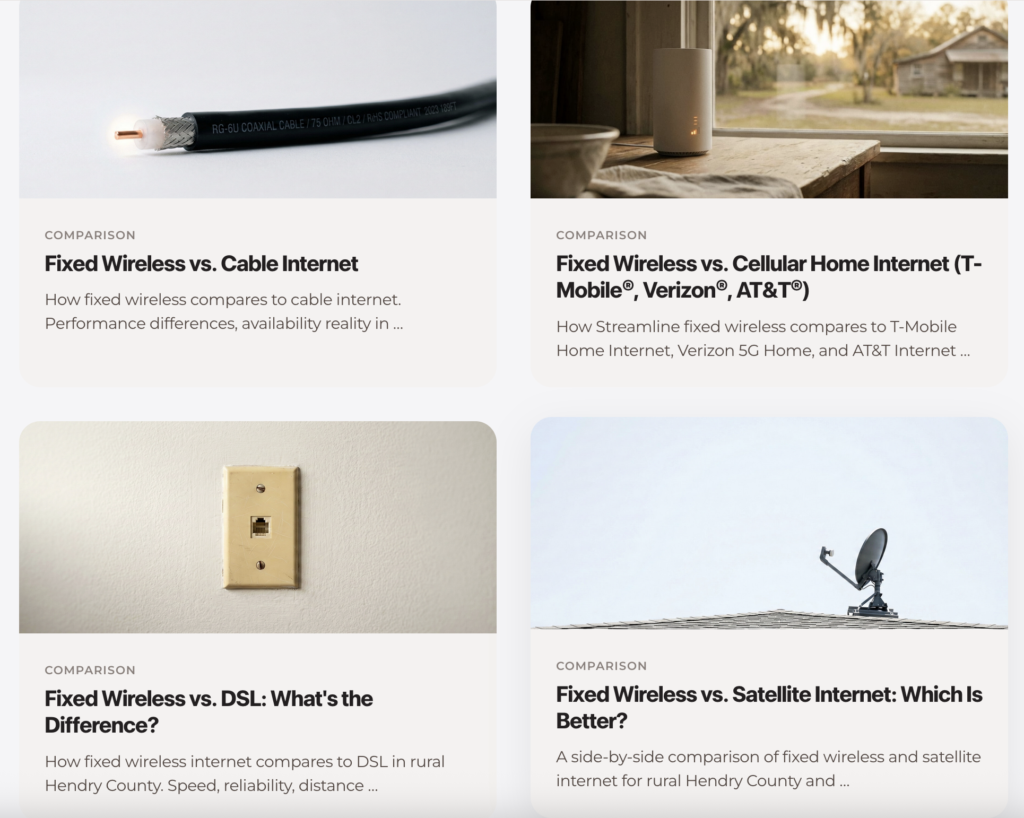
The single highest-leverage thing WISPA could publish is a suite of honest, plain-English comparison pages: Fixed Wireless vs. Fiber, Fixed Wireless vs. Cable, Fixed Wireless vs. Starlink, Fixed Wireless vs. 5G Home. Not marketing fluff, real engineering. The 811 problem. Path diversity economics. Local ownership. Latency reality vs. the satellite myth. Where each technology genuinely wins and where it genuinely loses. Members link up to these pages from their own sites. WISPA links down to member profiles. Suddenly the LLMs have a high-authority, structured, balanced source to cite, and it doesn’t end with “call Spectrum.”
2. The Deep-Data Member Directory (with Real Schema Markup)
Replace the static name-and-link directory with a real schema: service areas to the ZIP and census block, packages, pricing, features (no caps, no contracts, price-lock history, first responder and teacher discounts, IX participation, customer data privacy policy, US-based local support), tower coverage, executive bios, the engineering DNA of the network. The directory should let each member highlight where they shine. Some of us have never raised a price in a decade. Some of us peer at MGMIX or other regional exchanges. Some of us cut 25% off the bill for any deputy in our footprint. Right now none of that information lives anywhere a model can find it. For the small WISP with no website, this becomes their web presence overnight.
And let’s get specific for the developers, because “structured data” is too vague to ship from. Every member profile needs JSON-LD markup using LocalBusiness, Offer, and, critically, FAQPage schema. Don’t just list our names. Use FAQPage schema to answer questions like “Is fixed wireless better than cable in Bibb County?” or “Does Alabama Lightwave have data caps?” directly on the profile page, in the exact Q&A format LLMs use to talk to users. That is the format they ingest most effortlessly, and it is the format that gets cited back in answers.
3. Pass the Authority Down, and Train the Models While You’re At It
Optimized profile pages with clean backlinks pointing not just at member homepages, but at the packages page, the coverage map, the staff page, the business services page. The deep pages that actually need to rank in Google. SEO agencies charge four and five figures for a single backlink from a relevant DR 59 domain. WISPA could hand them out as a membership benefit and the dues would justify themselves on that alone.
But here’s the part most people miss: those backlinks are doing the Google job. They are not directly doing the LLM job. LLMs don’t run PageRank. They don’t read do-follow vs no-follow attributes the way Google’s algorithm does. What they care about is co-occurrence and entity association, unlinked brand mentions in semantic proximity to the words you want to be known for. (The asterisk worth naming: LLMs were trained on a web that PageRank shaped, so high-authority backlinks still matter indirectly, by making the pages they point to more likely to end up in the training set in the first place.) These are not competing strategies. They live in the same paragraph. A single profile entry can carry a clean do-follow link to the member’s packages page (feeding Google) while also mentioning the operator’s name in the same sentence as words like reliable, local, fast, no data caps, no contracts, first responder discount, locally owned, participates in regional IX, does not sell customer data, US-based local support (feeding the LLM). One tag, two wins. Skip the entity-association work and you leave the AI half of the equation on the table. Skip the do-follow links and you leave the Google half on the table. WISPA needs to ship both, in the same system, on the same page.
This is local peering for SEO, same way we keep regional traffic on MGMIX instead of leaking it to expensive transit, we should keep our industry’s domain authority and entity associations flowing inside the WISP ecosystem.
4. Authority Flows Both Ways, Coordinate the Big Operators
WISPA should be actively working its largest members to make sure they are linking back to wispa.org. Footer badges. “Proud WISPA member” pages. Press releases citing WISPA data. Co-published technical content. Every one of those links pumps authority into the domain that, in turn, pumps authority back down to the smaller operators who need it most. NCTA, CableLabs, and the regional cable associations already do this. They operate as a coordinated link economy. They cite each other. They co-publish. They feed the same shared authority pool that ends up recommending Spectrum to a customer in rural Alabama who has WISP options on their road and doesn’t know they exist. WISPA is the only entity that can lead the equivalent for us.
5. Mobilize the Community Signal (Reddit, Quora, Local Facebook)
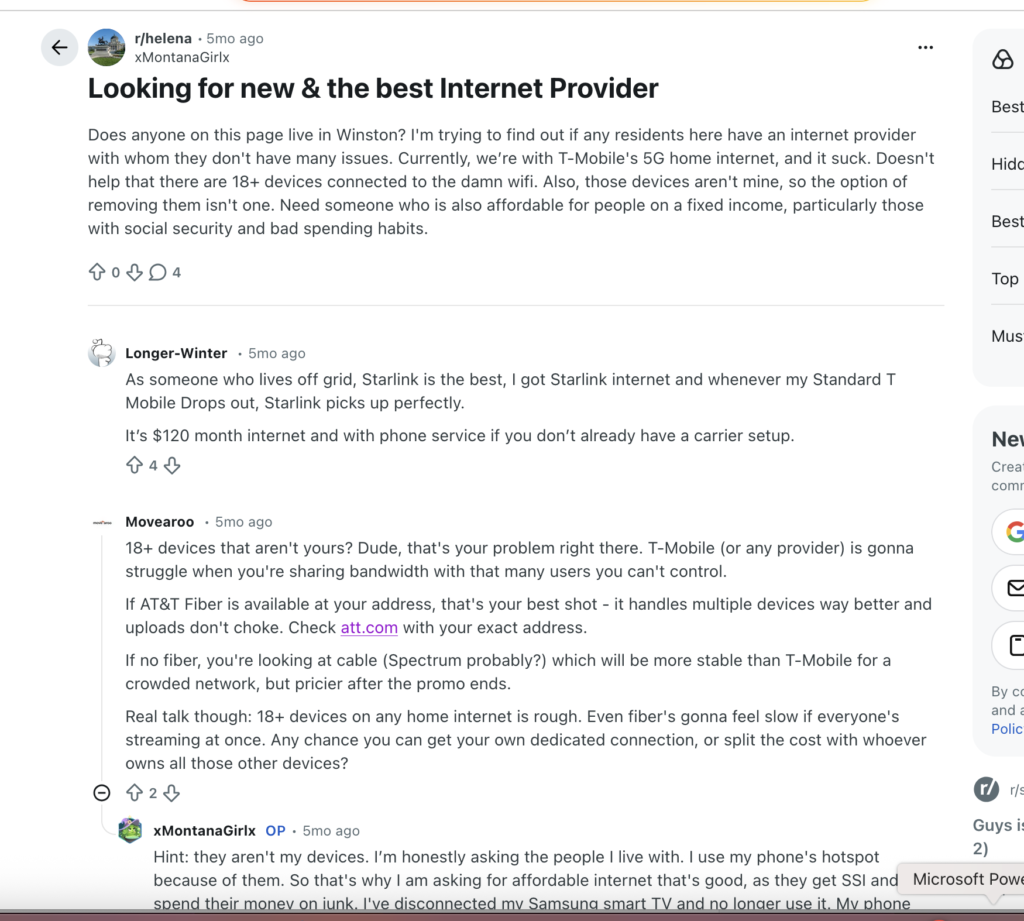
Here is the source pool I left out of my opening rant, and it might be the most important one: Reddit, Quora, and local community forums. LLMs weight “real human experiences” heavily when answering local recommendation questions. When somebody asks ChatGPT “what’s the best internet in Centreville,” it is absolutely pulling from local subreddits and Facebook groups looking for consensus. Affiliate-driven content ecosystems and review seeding have been shaping those threads for years, and the incentives all flow toward the operators with marketing budgets. We have something better, actual happy local customers, and we are not asking them to say so anywhere the AI will see it. WISPA should be running playbooks, templates, and quarterly campaigns helping members mobilize their existing customer base to share honest experiences on the platforms LLMs actually trust. Not astroturf. Real people, gently nudged to post the review they were already going to leave anyway.
6. Publish Primary Data, The Annual WISP Reliability Report
LLMs aggressively prioritize sources that supply net-new information over sources that just rehash existing web consensus. This is called information gain, and it is how a small site can leapfrog Spectrum’s PR machine. If WISPA publishes an annual WISP Reliability Report with original primary data, “WISPs suffer 80% fewer construction-related outages than buried fiber networks,” “Average WISP truck-roll response time is X hours faster than incumbent cable in counties under 50K population”, then any LLM answering a reliability question has to cite WISPA, because we are the only source for that specific statistic. Original data is the cheat code. The comparison hub in #1 needs this data feeding it. Spectrum cannot out-press-release a statistic only we own.
7. Stop Linking Out to the Competition
A simple editorial rule: WISPA-controlled channels do not pass link equity, attention, or authority to Spectrum, Comcast, AT&T, Verizon, or Starlink press cycles unless it is inside a comparison page where we control the framing and the conclusion. Inform members internally. Don’t amplify their wins on our domain, newsletters, or social media posts.
8. Win the LLM Citation Game
Ranking on Google is table stakes now. The next battle is becoming a citation in the answer the AI hands the customer. LLMs disproportionately cite structured, authoritative, frequently-updated sources with clear entity relationships. A properly built WISPA directory plus the comparison hub hits every one of those criteria. When somebody asks Claude “who provides internet in Bibb County, Alabama,” the answer should pull from wispa.org. Today it doesn’t. That is fixable this year.
The Bottom Line
We spend enormous energy on regulatory fights and broadband mapping battles. Those fights matter. But while we’re in the trenches in D.C., the cable companies are quietly winning the war for the customer’s first impression, the one that now happens inside an AI chatbot before a single Google search ever gets typed. And in some cases, we are helping them do it from inside our own newsletter.
WISPA already owns the asset that could flip this. A DR 59 domain with a decade of accumulated trust is not something the cable lobby can take away from us. We just have to actually use it, and we have to evolve from being purely an advocacy group into being the central data broker for our industry’s AI reputation. That is a real paradigm shift. It is also the only thing that will work. Build the comparison hub. Ship the rich directory with proper schema. Pass the authority and the entity associations down. Coordinate the link economy with the big operators. Mobilize the community signal. Publish primary data nobody else has. Stop amplifying our competition on our own channels. Get our members cited by the machines that are answering customer questions today.
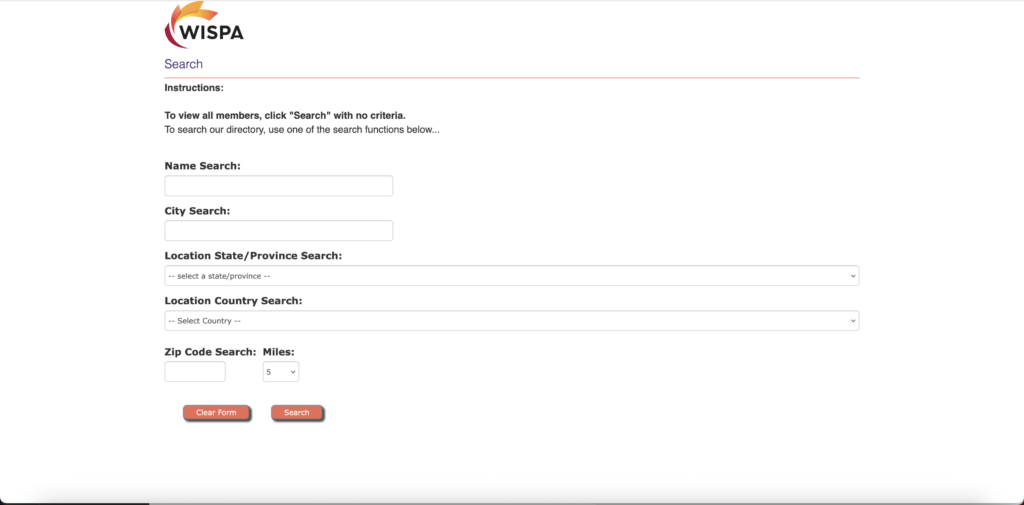
I think Prince might’ve written a song about this member directory.
So tonight we gonna party like it’s 1999.
David, team, I know you’re working hard, and I want WISPA to succeed because when WISPA wins, every member on this list wins with you. But we need a communications strategy change, and we need it this month, not next year. Everything above is practical, shippable, and inexpensive compared to what it would deliver.
Enjoyed this article?
Enter your email below to get notified when new posts go live.
Leave a Reply