

You were on a tower last Tuesday. Your phone rang halfway up. Customer with a service issue, same guy you helped last month. You took the call because there’s no helpdesk, no tier-one support team, no one else. That’s the job. It’s always been the job.
What changed is everything around it. Somewhere between the CPNI certification and the third SAS invoice and the BDC filing you couldn’t afford to do right, Washington stopped building rules for people like you. They didn’t do it on purpose. They just forgot you were out here.
In Prince Caspian, the Pevensie children return to Narnia and barely recognize it. Their own castle lies in ruins while a Telmarine regime rules from its own. The Old Narnians survive in the woods. The Telmarines conquered Narnia because they could, drove its original inhabitants into hiding, silenced the talking trees, and rewrote the history until the old Narnia was something most people no longer believed had existed at all.

Washington policymakers arrived at the same result through quieter means. No conquest. Just process, applied without proportion, until the people who built rural broadband found themselves surviving in the regulatory woods.
What Was Lost
The broadband regulatory architecture seems to be built for AT&T, Verizon, Charter, and Comcast, organizations with legal departments and regulatory affairs divisions whose full-time job is Washington. Every major compliance framework, from BDC filings and CPNI certifications to CALEA obligations and SAS coordination, assumes that kind of infrastructure.
Look at what a typical quarter demands from an operator running six towers in a rural county. You submit geospatial coverage data that either gets done by hand, probably wrong, or you hire a respected firm like Regulatory Solutions to do it right, which costs real money. You maintain CPNI certifications. You coordinate every CBRS radio and customer device through a commercial Spectrum Access System. You respond to BDC challenges from subsidized competitors at your own expense, all while climbing towers and taking support calls on your personal cell phone.

Every one of those obligations barely registers on Comcast’s balance sheet. For you, they’re brutal. SAS fees running two to three dollars per device per month, legal and certification overhead that doesn’t scale down just because your subscriber count did. Ask small operators what compliance costs them – the numbers are brutal in an environment of tight capital and grant funded over-builders marching on the horizon. For national carriers, the same obligations are a rounding error.
Then there’s the NPRM process, where small operators get buried quietly. The shaping of rules begins long before the comment window opens. Large carriers maintain permanent lobbying operations in Washington, taking ex parte meetings with FCC staff and influencing rule language while it’s still in draft. By the time a small WISP operator reads twenty pages of regulatory language after the kids go to bed, the game is already rigged. The system offers participation but withholds access.
Honest About the Woods
Lewis didn’t romanticize the Old Narnians into spotless saints, and we shouldn’t romanticize small operators either. Some of these regulations exist because real failures demanded real responses: poor network security, customer data screw-ups, exaggerated coverage claims filed to block competitors from receiving subsidies. The fences were built for reasons.

G.K. Chesterton understood this tension well: “Government has become ungovernable; that is, it cannot leave off governing. Law has become lawless; that is, it cannot see where laws should stop.” The regulations were born from legitimate problems. But they were built to the scale of giants and applied without distinction to everyone beneath them.
And we must be honest about our own contradictions. Our industry has cashed CAF II, RDOF, and BEAD checks. We cannot claim pure outsider status while also cashing the checks. But the operators who built networks with maxed-out credit cards are still here, still connecting neighbors that Wall Street ignored. What we can claim is that compliance should be proportional to scale.
Rikas, a German indie band with more soul than most acts twice their size, wrote a song called Strangers that traces how people drift from intimacy to alienation, how those who once shared a common language end up unable to recognize each other at all. That is the arc. Not betrayal. Just drift. Until the people who built the thing and the people who regulate the thing became strangers to each other.
“Isn’t it strange how people can change
From friends into lovers and strangers again”
Still Out Here
Washington forgot. But we didn’t leave. And what’s left is not helpless. It just needs a system that recognizes it exists.
I’ve spent a lot of this piece observing and complaining. So here are two immediate, concrete wins that Washington policymakers could act on now. Both would ease the burden on small operators more efficiently than chasing WISPs to file paperwork they can’t afford. Both could likely be funded from pots of money already authorized. And both would put the work in the hands of people who know what they’re doing.
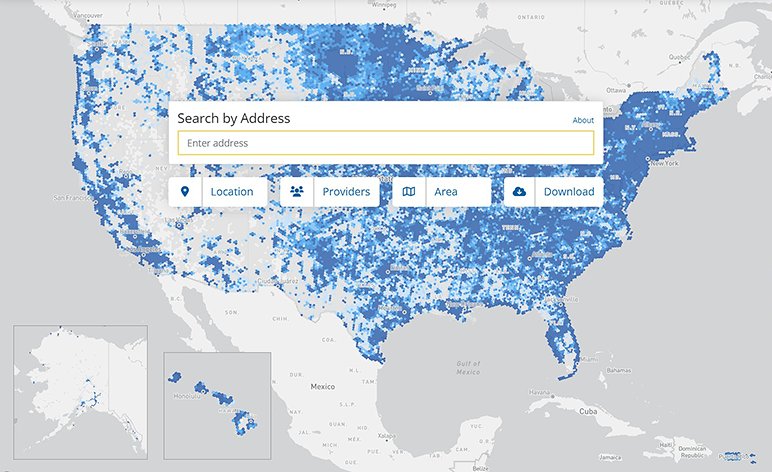
First: subsidize BDC filings. Firms like Regulatory Solutions already do this work well. The industry trusts them. Let WISPA vet and maintain a list of qualified filing firms, let small operators choose from that list, and let Washington cover the cost. Substantial federal money has already gone to fiber companies to overbuild areas where wireless was already serving customers. Picking up the filing costs for Main Street WISPs is modest by comparison. And everybody wins: small operators get immediate compliance cost relief, national telecom companies chasing BEAD funding get reliable data about where coverage expansion is necessary, and consumers get an accurate broadband map with local internet options that may not have even known existed before.
Second: let fixed CPE register through the access point. CBRS shares spectrum with U.S. Navy radar, and the SAS exists to ensure zero interference with federal defense operations. That is a national security imperative, and I respect it. But the access point already handles environmental sensing, power management, and SAS coordination. The CPE is a dependent client that cannot operate outside those controls. A proxy model could achieve equivalent protection at a fraction of the cost and would reduce signaling clutter in the SAS database, giving the Navy a cleaner picture of the band when they need to clear it. WISPA has advanced similar proposals. Washington may not be entirely free to act here; the Department of Defense is notoriously conservative about incumbent spectrum protections, and the FCC often functions as middleman enforcing what the Navy requires. That makes the conversation harder, but not less necessary.
Two fixes. Both achievable. Both overdue.
The Horn
In Prince Caspian, when the war against the Telmarines is going badly and every official strategy has failed, Caspian blows Susan’s horn. Not as a war cry. Not as a demand for the castle to fall. As the last available signal from people who had exhausted every other option and still couldn’t win alone.

That’s this article. That’s every WISPA filing. That’s every small operator who showed up to a proceeding in Washington and realized the language in the room wasn’t built for them.
Washington does not need to be torn down. Spectrum must be managed and consumers must be protected. But the rulebook needs to reckon with the people underneath it.
The Old Narnians spent three hundred years in those woods. Not defeated. Just erased.
We’re still out here. And we’re done being invisible.
Sources and Citations
SAS fees of $2-3 per device per month: Google’s SAS pricing was announced at $2.25/month per household for fixed wireless at WISPAmerica. Other SAS administrators charge comparable rates. Light Reading: “Google Puts a Price on CBRS SAS: $2.25/Month Per Home” | Google Cloud SAS Billing Documentation
100,000-subscriber threshold: The FCC used this threshold for broadband label compliance deadlines (April 2024 for large providers, October 2024 for those at or below 100,000 subscribers). The November 2025 FNPRM on broadband labels continues to reference this threshold and proposes further streamlining for small providers. FCC Broadband Consumer Labels | FCC 25-74 FNPRM (PDF) | SBA Office of Advocacy
BEAD funding to fiber companies overbuilding WISP-served areas: Under original BEAD NOFO rules, NTIA classified fixed wireless over unlicensed spectrum as “unreliable,” making WISP-served areas eligible for subsidized fiber overbuild. WISPA CEO David Zumwalt and multiple WISP operators documented this extensively. The Trump administration’s 2025 BEAD revision reversed this policy. Telecompetitor: “Will Unlicensed Fixed Wireless Technology Make the Cut with the BEAD Program?” | Light Reading: “What’s Going on with Fixed Wireless and BEAD?” | Broadband Breakfast: “New Mexico WISP Fears Overbuilding”
CBRS shares spectrum with U.S. Navy radar; SAS protects federal incumbents: The CBRS band (3550-3700 MHz) operates under a three-tier priority system with federal incumbent users (primarily Navy radar) at the top. Google Cloud SAS Overview | Celona: CBRS SAS Explained
CPE registers independently with SAS; proxy model proposed by WISPA: Google SAS billing confirms fixed wireless pricing is billed per CPE. WISPA has advanced proxy registration proposals in FCC dockets. Google Cloud SAS Billing | WISPA Regulatory Guidance
DoD conservative on incumbent spectrum protections; FCC as middleman: WISPA VP of Spectrum Richard Bernhardt has publicly discussed these interagency dynamics. RCR Wireless: “CBRS and the Uncertain Future of Spectrum Sharing”
NPRM process and ex parte meetings: FCC ex parte rules (47 CFR 1.1200 et seq.) govern communications with staff during rulemaking. Ex parte meeting logs are public record. FCC ECFS (Electronic Comment Filing System)
G.K. Chesterton quote: From Eugenics and Other Evils: An Argument Against the Scientifically Organized State (1922). Goodreads source
Rikas, “Strangers”: German indie band. Listen on Spotify
CAF II, RDOF, BEAD: Federal broadband subsidy programs in which WISPs have participated and received funding. WISPA overview on Broadband Breakfast


Leave a Reply